
How Denton County Warrants Work
Most warrants tracked through the county's public Warrants page start with a citation. When a state trooper, a game warden, or a county deputy writes a ticket, that case is handled in a Justice of the Peace court. The JP court sets a date and an amount. The defendant is expected to respond. Pay, appear, or set a hearing. Those are the usual paths.
Trouble starts when nothing happens. If a person does not resolve the matter with the court, the judge can issue a warrant for arrest. In Denton County, that warrant does not just sit in a file. It goes to the Constable's office, and the constable serves it. So the court issues the warrant and the constable carries it out. This split is a local division of labor, and it matters because the court holds the case while the constable holds the order to arrest.
This pathway is tied to JP-level citations. It is not a full countywide list of every felony warrant, every city warrant, or every sealed warrant. A traffic-based warrant and a felony capias are very different animals, and they live in different systems. For broader case history you can also check Denton County court records.
Note: warrants tied to citations from troopers, game wardens, and county deputies are the ones the county's Warrants page is built to help you check.
How Citations Become Denton County Warrants
A ticket is not a warrant. It is a charge with a court date and an amount. The case opens in the proper JP precinct, and the defendant has a window to act. Pay the fine, show up, post a bond, or ask for a court setting. Doing any of these on time keeps a warrant off the table.
When the window closes with no response, the picture changes. The judge can sign a warrant for failure to appear or failure to pay. From that point the case carries an active warrant, and the constable can serve it. A routine stop, a license check, or a knock at the door can lead to an arrest. The longer a warrant sits, the more fees and complications tend to stack up. Traffic matters in particular flow through the Justice of the Peace courts, so the precinct on your citation tells you where to look. For ticket-level detail, the traffic court records page covers citation lookups and payment.
One detail trips people up. Online payment does not happen in real time. The county notes that an online payment is not processed until the next business day, and an outstanding warrant may not be recalled until the payment posts. So a payment made late at night does not clear a warrant that same night.
How to Search for a Denton County Warrant
The county gathers warrant help on its Warrants page. That page explains the trooper, game warden, and county deputy pathway, and it links the JP #3 Payment Portal so people can check and pay. If you are not sure which court has your case, the page lists JP precinct phone numbers so you can call and ask. A phone call to the right precinct is often the fastest way to confirm a warrant.
The portal asks for a few details from your citation or civil document. The precinct number, the amount, and the docket or cause number are the core inputs. The table below lists the fields used to check and pay through the JP portal.
| Field Label | Required | Notes |
|---|---|---|
| JP Precinct Number | Yes for payment | Must match the citation or civil document |
| Amount to Pay | Yes | The amount due on the case |
| Docket Number or Cause Number | Yes | Needed for processing |
| Email Address | Optional | Used to send a receipt |
| Payment Card | Yes if paying online | Visa, MasterCard, or Discover; American Express is not accepted |
The county page is the lead-in to that portal. The image below shows the Constable Warrants page.
Visit the county Denton County Warrants page for the warrant check pathway and the JP precinct phone list.
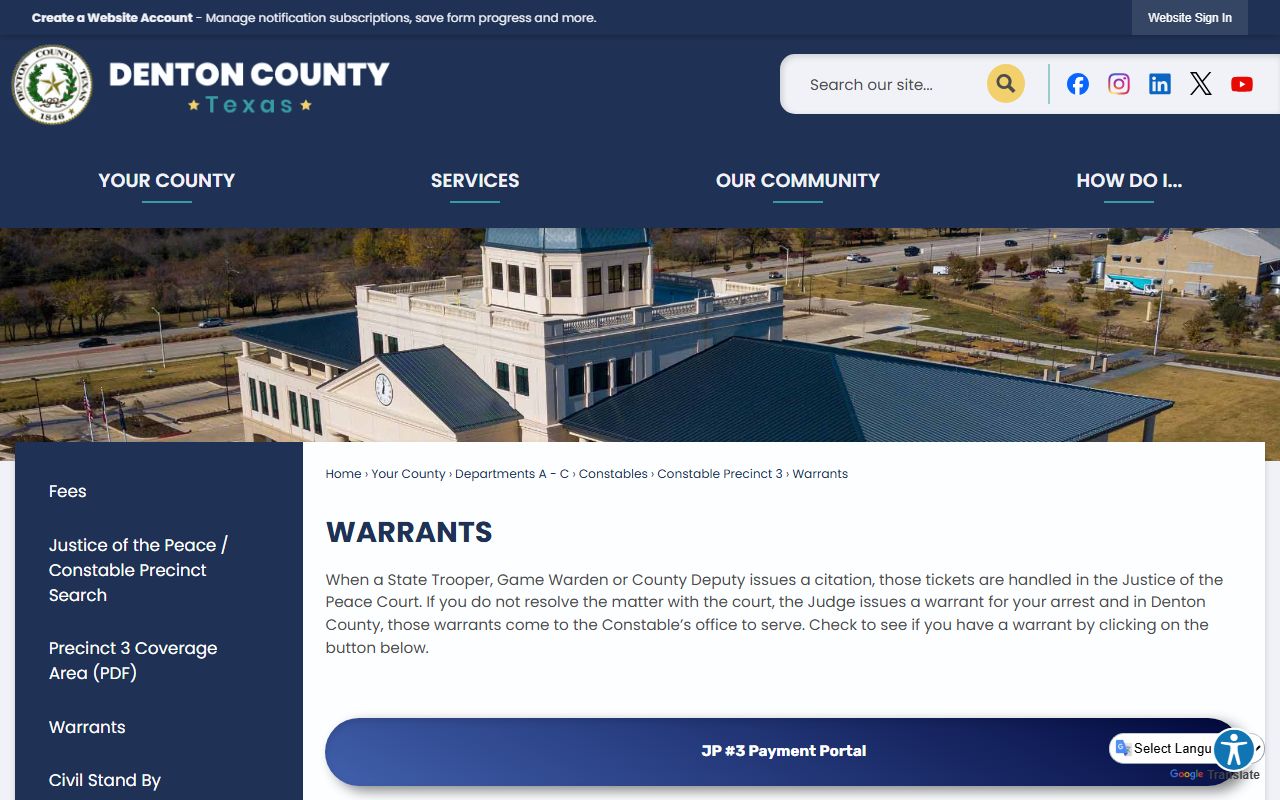
From there the page sends you to the JP #3 Payment Portal to look up a warrant and the balance due.
Types of Denton County Warrants
A warrant is a court order, but not every warrant means the same thing. Some come from a missed court date. Some come from an unpaid fine. Others are signed by a judge to bring a person before the court or to allow a search. Knowing the type helps you know which court to call and what to do next.
- Arrest warrant - a judge's order to arrest a named person on a charge.
- Bench warrant - issued from the bench, often when a person misses a required court date.
- Capias - an order to take a person into custody and bring them to court.
- Capias pro fine - issued when a fine and costs go unpaid after a judgment.
- Search warrant - allows officers to search a place for evidence.
- JP traffic warrant - tied to an unresolved Justice of the Peace traffic citation.
- Failure-to-appear and failure-to-pay warrants - signed when a defendant misses a setting or skips payment.
- Bond-forfeiture warrant - issued when a defendant on bond does not meet a condition.
- Probation-violation warrant - issued when terms of supervision are broken.
- Sealed warrant - tied to a sealed case; may not show publicly until an arrest or court action.
Felony warrants, probation-violation warrants, and district-court capiases may not show up in a JP payment portal at all. Those route through the county records portal, the criminal courts, or the Sheriff. For booking and charge detail, see arrest records.
What a Denton County Warrant Record Shows
A warrant record is a small set of fields. It names the person, the court, and the charge, and it tracks the balance and status. When you check the JP portal or call a precinct, these are the fields that drive the search and the answer you get back. The cause or docket number is the anchor, much like it is for a full court file.
| Field | What It Shows |
|---|---|
| Warrant Type | Arrest, bench, capias, capias pro fine, or another category |
| Issuing Court / Precinct | The JP precinct or court that signed the warrant |
| Cause or Docket Number | The case identifier used to look up and pay |
| Charge | The offense or citation behind the warrant |
| Amount / Balance Due | Fine, costs, and any balance owed on the case |
| Issue Date | The date the judge signed the warrant |
| Status | Active, recalled, or resolved |
Some fields may be limited by what the court has entered. The portal helps you check and pay, but the court file is the source of truth for the case itself.
What to Do About an Outstanding Denton County Warrant
An open warrant will not clear itself. The good news is that the path to resolve one is fairly clear once you find the right court. The steps below follow the county's own guidance for handling a JP-level warrant. Take them in order, and do not skip the jail-credit question if it applies to you.
- Find the correct JP court and precinct from your citation or civil document.
- Search the JP #3 Payment Portal or call the precinct from the county phone list.
- Confirm whether a warrant exists and ask for the total balance due.
- If you have been in jail recently, ask whether jail credit applies to your cases.
- Decide whether to pay, appear, post a bond, or request a court date.
- Keep your receipt and confirm the warrant is recalled after the payment posts.
- Talk to an attorney before paying if the case could affect your license, a CDL, immigration, or a professional license.
Paying is not always the simple choice. It can resolve a small fine fast, but it can also carry weight you did not expect. The next section explains why a quick payment is sometimes a plea, and why a call about jail credit can save you money.
Jail Credit and Warrant Recall in Denton County
Two timing facts matter most before you pay. First, time you already spent in jail may count against what you owe. Second, paying online does not clear a warrant on the spot. The county is clear on both points, and missing either one can cost you money or leave you exposed to arrest when you thought you were clear.
Important. The county Warrants page says that if you have been in jail recently, you should call and ask about requesting jail credit on your cases before you pay, because time served may reduce or change what you owe.
Recall timing is the other trap. An online payment is not processed until the next business day. If there is an outstanding warrant, it may not be recalled until the payment posts. So do not assume a late-night payment makes you safe that same night. Wait for the posting, keep the receipt, and confirm with the court that the warrant is recalled. If you were booked and then released, the inmate records page can help you confirm dates that may support a jail-credit request.
Paying a Warrant Can Be a Plea
People often think paying a ticket just makes it go away. In a fine-only case, it can do much more than that. The county's JP payment page warns that payment constitutes a plea of nolo contendere, also called no contest. That plea has real effects on your record and your rights.
Under the Code of Criminal Procedure Article 27.14(c), payment in a fine-only misdemeanor operates as a finding of guilty in open court and a waiver of a jury trial. In plain terms, paying can close the door on fighting the case. The image below shows the JP #3 payment and warrant lookup portal.
Open the JP #3 online payment portal to look up a warrant, view the balance, and pay if you choose.
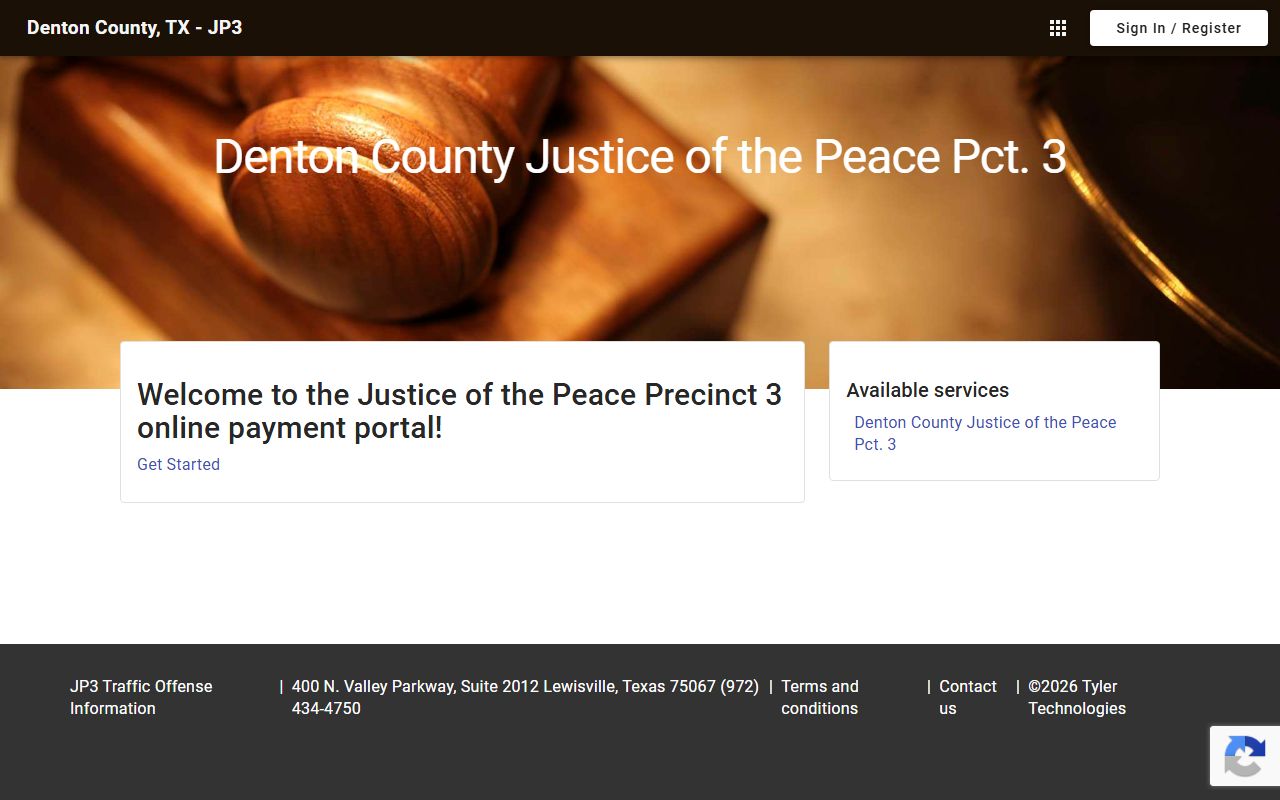
Online payment is limited to adult defendants age 17 and over for offenses committed after age 17. A 2.75% processing fee applies. Visa, MasterCard, and Discover are accepted, but American Express is not. If a case could affect your license, a CDL, immigration status, or a professional license, talk to a lawyer before you pay.
Restricted and Out-of-Scope Denton County Warrants
The JP warrant pathway does not reach every warrant. Some cases cannot be handled through the adult online payment system at all, and some warrants simply live in other systems. Knowing the limits keeps you from paying the wrong court or assuming a search is complete when it is not.
Juvenile and minor cases are handled apart from ordinary adult online payment. Defendants under 17, and minors over 17 charged with alcohol or tobacco offenses, must appear in person with a parent or legal guardian. Juvenile warrants and records are restricted by law, and a child's case may not be viewable online. Sealed indictments and sealed warrants may not show publicly until an arrest or until the court unseals the case.
Court systems also differ by level. City citations route to municipal courts, such as the City of Denton Municipal Court, which run their own warrant and payment systems. Felony and district-court warrants run through the county records portal, the criminal courts, or the Sheriff, not the JP portal. Out-of-county and out-of-state warrants can lead to an arrest in Denton County, but the issuing agency or court must resolve them. For sealing and confidentiality basics, the court records page covers what stays closed.
Note: a JP payment portal check is not the same as a full background check, so confirm felony, municipal, and out-of-area warrants with the office that issued them.