How to Search Denton County Court Records
Denton County puts its public lookup links in one place. The county's Judicial & Law Enforcement Records Search page is the safest landing spot. It gathers case records, court calendars, Sheriff jail and bond records, and the Texas convictions database behind a single county disclaimer. The page is blunt about limits. It warns that displayed records are subject to data-entry limits and that judgment details can be verified only by the actual court records on file. So treat the portal as a finding tool, not as proof.
The county routes most public case lookups through the Denton County Records portal. Before you start, have a name or a cause number ready. A date range helps too.
The screenshot below shows the county gateway that links each official search.
Denton County Judicial & Law Enforcement Records Search is the county's own hub for these links.
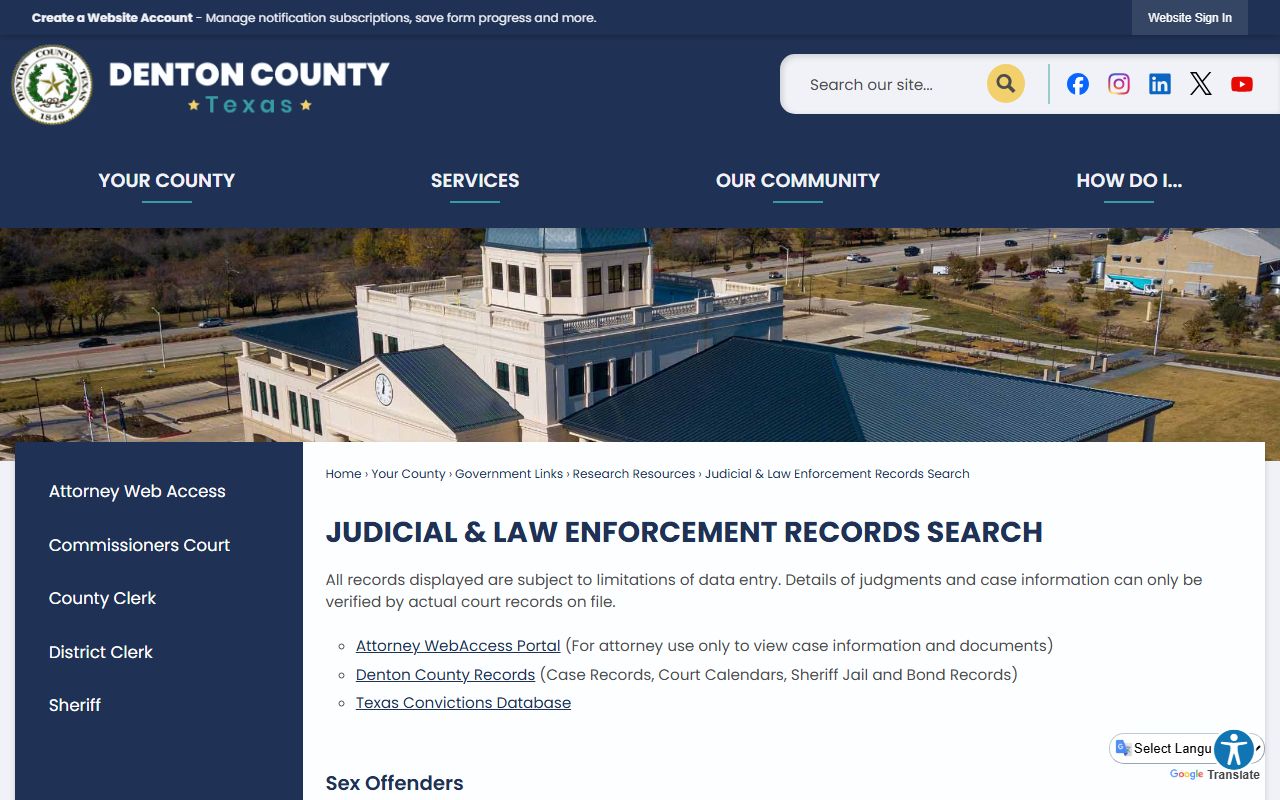
From that hub you reach the portal, the calendars, and the jail and bond record links without leaving an official county domain.
- Open the county hub at dentoncounty.gov and choose "Denton County Records."
- Pick a search type, then enter a party name or the cause number.
- Narrow the results by court and by filing date.
- Review the docket entries and case status the portal shows.
- For a certified copy, submit a request form to the District Clerk or County Clerk and pay the fee.
The portal itself sits behind a session screen. The next image shows that entry point.
You can preview the Denton County Records portal here.
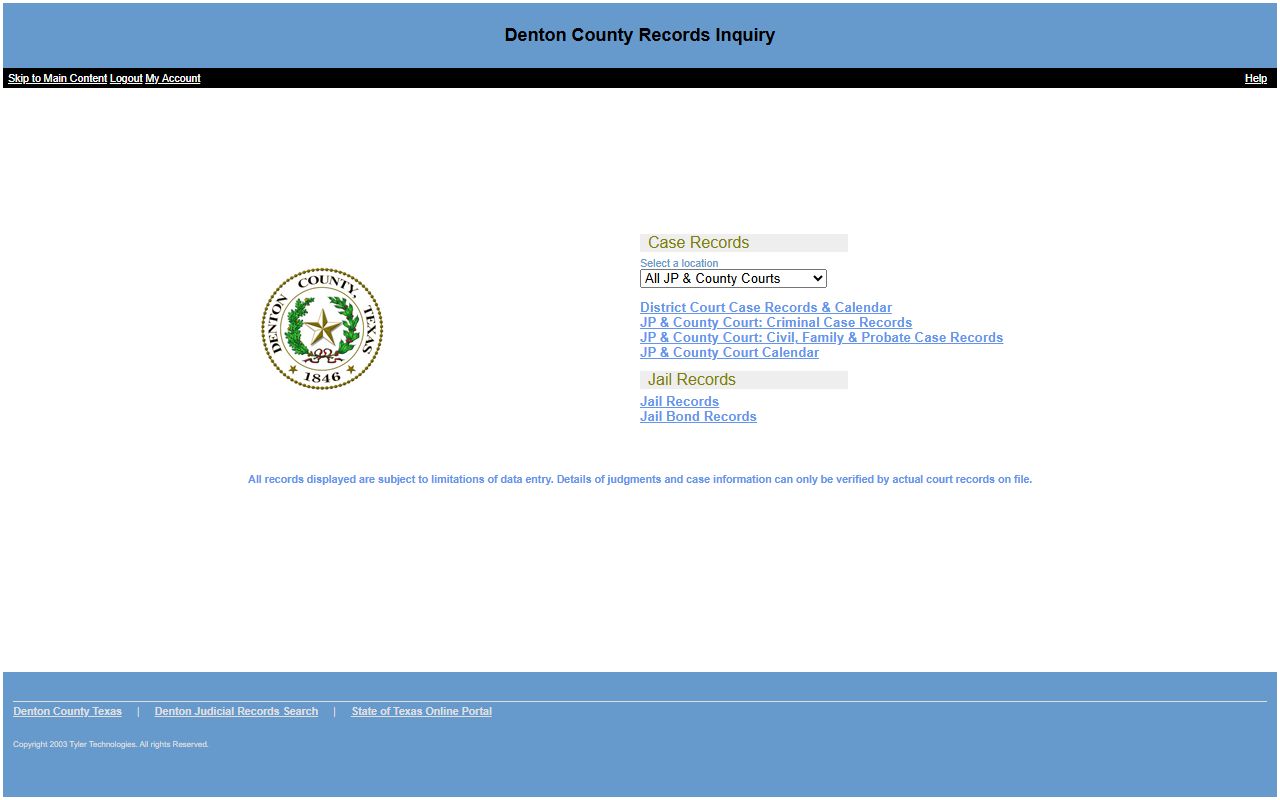
Because the portal uses a login or session step, follow the on-screen prompts. Public users can view case records, calendars, and jail and bond records once inside.
The Denton County Judicial System
Texas stacks its courts from the top down. The Supreme Court of Texas and the Court of Criminal Appeals sit at the top, followed by the courts of appeals, the district courts, the county-level courts, the Justice of the Peace courts, and the municipal courts. Denton County fits inside that statewide frame. District courts are the general trial courts. They take felony cases, family-law matters, and larger civil disputes. County courts at law and county criminal courts handle misdemeanors, juvenile work, and many smaller civil cases. The two statutory probate courts manage estates, guardianships, and mental-health matters.
The county's own County Courts page lists thirteen court and program entries, from County Court at Law 1 to the Veterans Treatment Court. The image below shows that landing page.
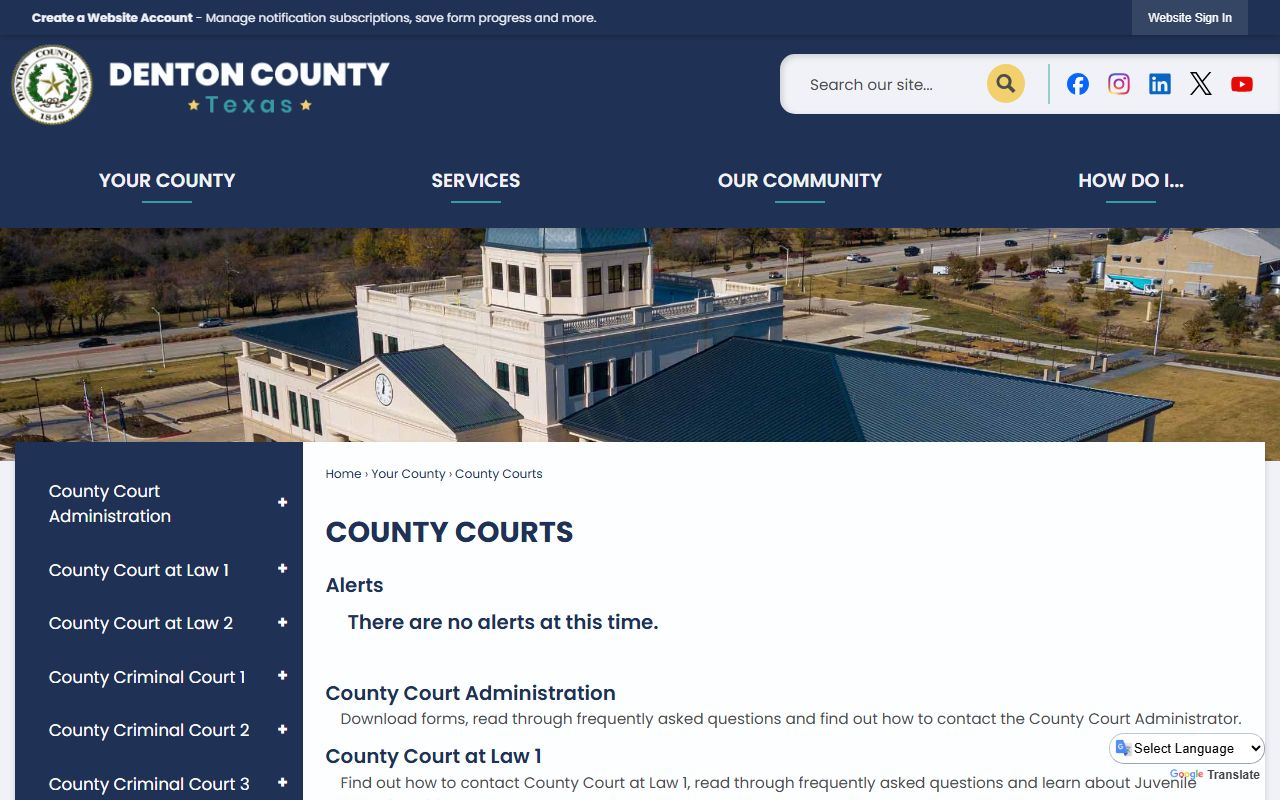
Each numbered court keeps its own docket and contact block, so the landing page is a useful map of who hears what.
Case flow: Justice Court › County Court › District Court › Court of Appeals
| Court | Jurisdiction | Case Types |
|---|---|---|
| District Courts | General trial courts | Felonies, larger civil suits, divorce and family law |
| County Courts at Law / Criminal Courts | Statutory county courts | Misdemeanors, juvenile matters, mid-size civil cases |
| Statutory Probate Courts | Probate jurisdiction | Estates, guardianships, mental-health commitments |
| Justice of the Peace Courts | Limited jurisdiction | Class C tickets, small claims, evictions |
| Municipal Courts | City jurisdiction | City ordinance and city traffic citations |
An example district court page makes the structure concrete. The 16th District Court, led by Judge Sherry Shipman, sits on the third floor at 1450 East McKinney Street and publishes its own docket section.
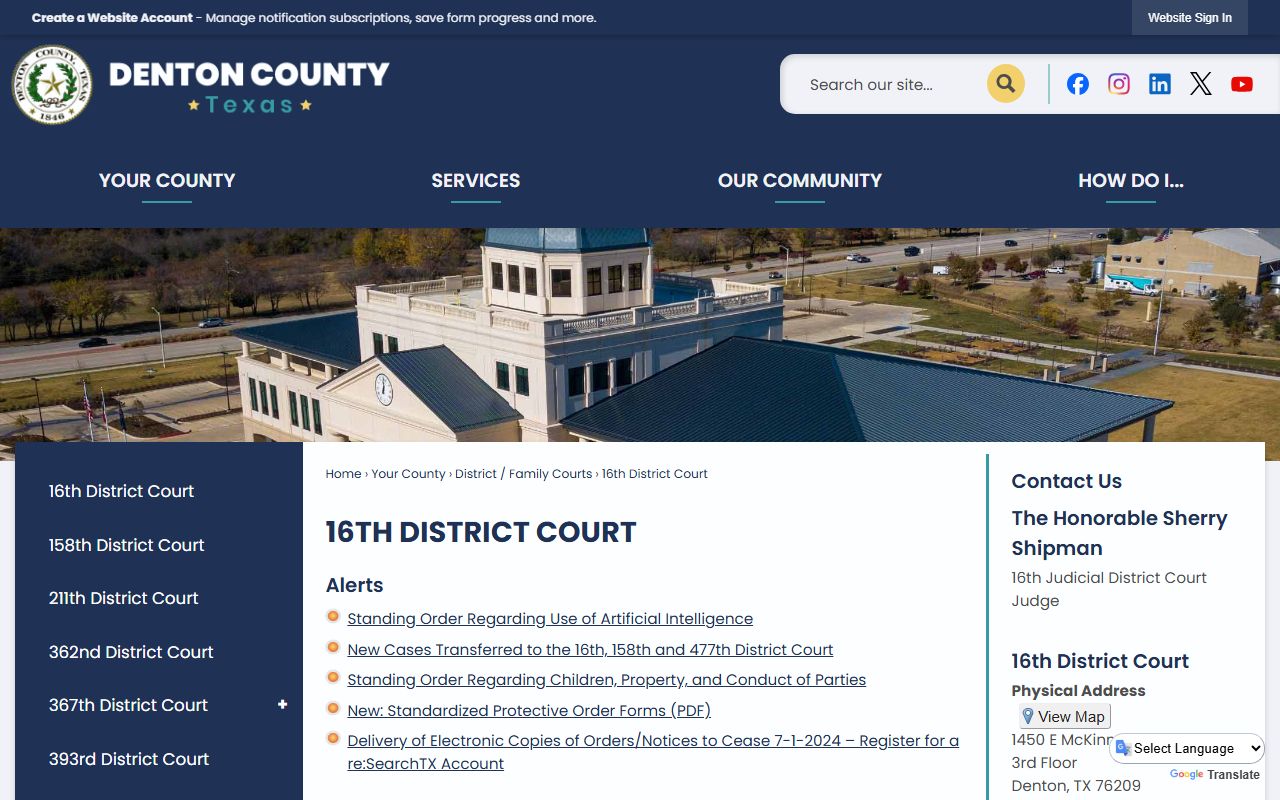
Note that the page warns visitors not to contact a judge directly about a pending or potential case.
District Clerk and County Clerk in Denton County
Texas splits the clerk job in two, and Denton County is no exception. The District Clerk, David Trantham, is the registrar and custodian for pleadings and papers in civil and criminal district court cases. That office holds divorce decrees, felony case files, and other district records. It has supported electronic filing since 2012. The screenshot below shows the District Clerk page.
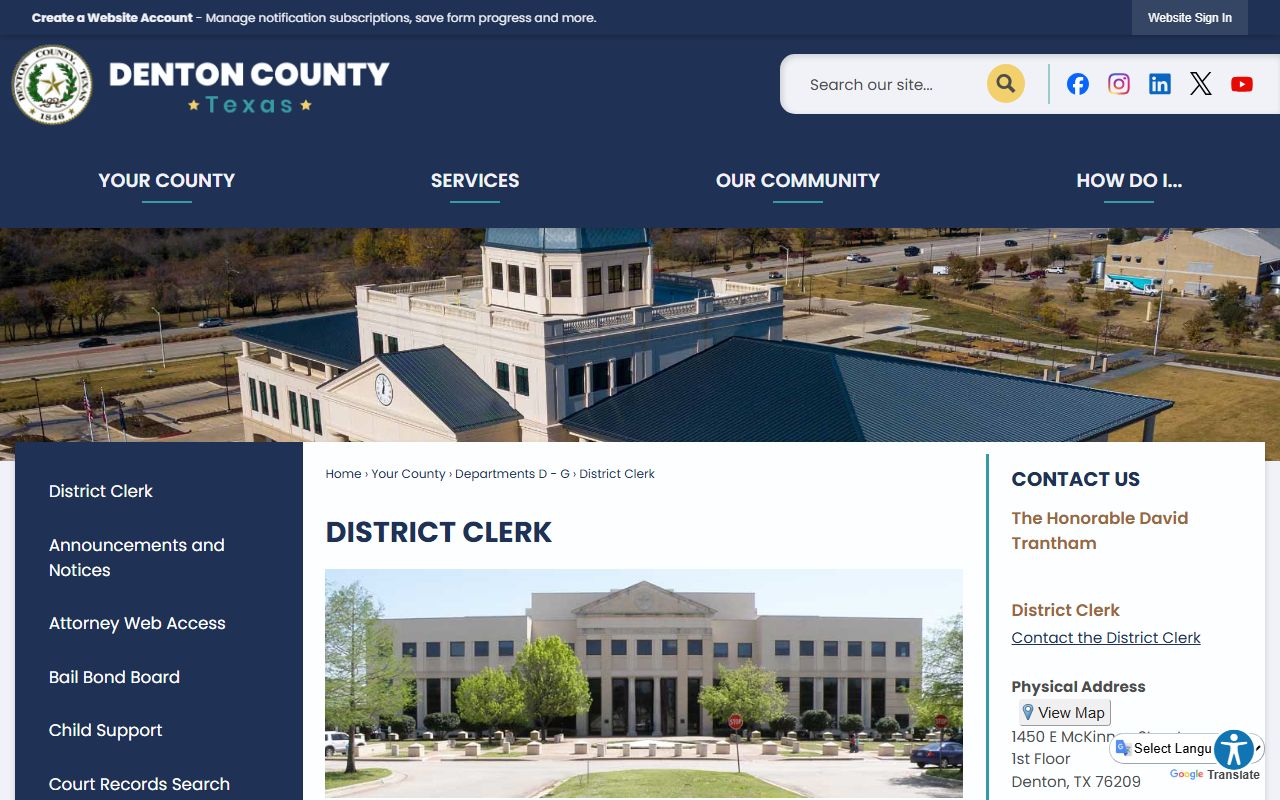
The District Clerk will not run a request without a completed Record Request Form, so plan to file one for any district court copy. More detail lives on the Denton County District Clerk page.
The County Clerk, Juli Luke, is the other half of the system. That office is the official record keeper for real property, vital statistics, civil court, misdemeanor court, probate court, and juvenile court records. The image below shows the County Clerk page and its search buttons.
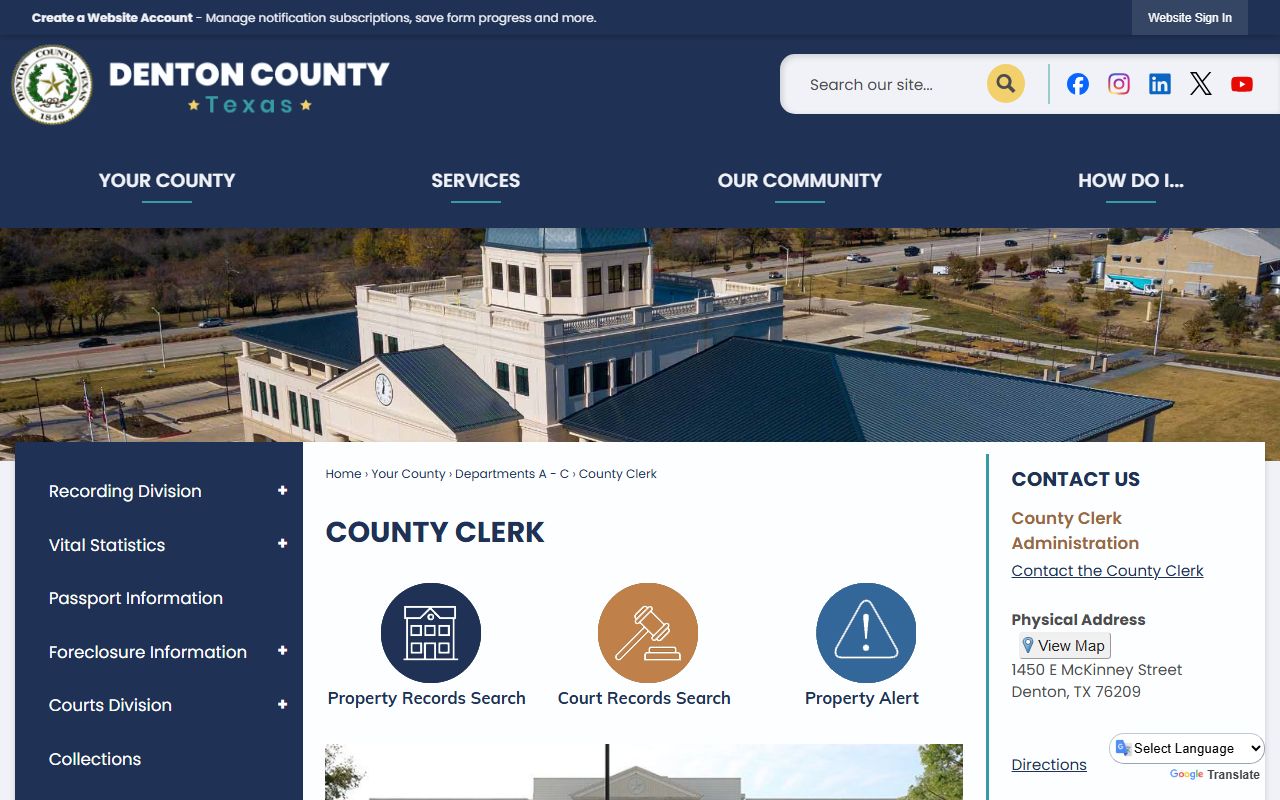
Sending a request to the wrong clerk is the most common Denton County records mistake. This table sorts it out. Full detail is on the Denton County Clerk page.
| Record Need | District Clerk | County Clerk |
|---|---|---|
| Felony case files | Yes | No |
| Divorce and family law | Yes | No |
| Misdemeanor court records | No | Yes |
| Probate and guardianship | No | Yes |
| Marriage licenses, real property | No | Yes |
Types of Court Records Available in Denton County
Denton County court records cover a wide spread. Each court makes its own kind. The records below are the ones people search for most often, and each links to the office or page that holds it. Some are open to anyone. Others, like juvenile files, are closed by law.
- Criminal records - felony files at the District Clerk, misdemeanors at the County Clerk.
- Civil records - lawsuits, judgments, and orders from district and county courts.
- Family and divorce records - decrees and custody files kept by the District Clerk.
- Probate records - wills, estates, and guardianships in the two probate courts.
- Traffic records - Class C citations handled in JP and municipal courts.
Real property, marriage, and recorded instruments form a separate group. They are public, but they are not court case files. The County Clerk keeps those on a different search platform.
What Denton County Court Records Show
A case record is more than a name. It is built from fields that the clerk enters as a case moves. Denton County request forms and the portal's coverage statement point to the fields below. The cause number is the key. District examples take forms like F22-1489-362, and the suffix often marks the court number. Once you have that number, the rest of the file opens up.
| Field | What It Shows |
|---|---|
| Case Number | Unique cause number that identifies the case and often the court |
| Filing Date | Date the case or document was filed with the clerk |
| Parties | Names of the plaintiff, defendant, petitioner, or respondent |
| Charges / Cause | The charge in a criminal case or the claim in a civil suit |
| Disposition | The outcome, such as dismissed, convicted, deferred, or granted |
| Sentence / Judgment | The penalty or the final ruling that resolves the case |
For the County Clerk's recorded records, the search form itself shows you the fields. The quick search supports the controls below. The court records page walks through each one.
| Field Label | Type | Notes |
|---|---|---|
| Department | Dropdown | Real Property and other recorded categories |
| Search Term | Text | Grantor, grantee, subdivision, document type, or number |
| Date Range | Date | Recorded date, with preset ranges from 24 hours to 1 year |
| Search Scope | Radio | Index only, or index and full text (OCR) |
Public Access Laws for Denton County Court Records
Two legal tracks govern records in Denton County. County administrative records, like Sheriff files, fall under the Texas Public Information Act, Government Code Chapter 552. Court case files follow a different path. Government Code Section 552.0035 hands judiciary access to rules set by the Texas Supreme Court, and Rule of Judicial Administration 12 covers a judicial agency's administrative records. So a pleading or docket sheet goes through the clerk, while a judge's administrative record may be a Rule 12 request. The county's own search page repeats the warning that case details must be checked against the actual court file.
Key Statutes:
Texas Government Code § 552 - the Public Information Act; openness is the default for government records unless the law says otherwise.
Texas Government Code § 552.0035 - sends access to judiciary information to rules adopted by the Supreme Court of Texas.
Texas Rule of Judicial Administration 12 - public access to a judicial agency's administrative records, not case files.
Texas Code of Criminal Procedure Chapter 55 - expunction of eligible arrest and criminal records.
For a deeper look at request methods and timelines, see the Denton County public records page.
Records That Are Restricted or Confidential
Not every Denton County court record is open. Juvenile cases are civil and largely closed. County Court at Law 1, which handles juvenile work, notes that a child's case usually cannot be viewed online. Sealed and expunged criminal records will not be released unless the law allows it. Adoption files and mental-health commitments are protected too. Personal identifiers like Social Security numbers, driver license numbers, and financial account numbers are redacted from public copies.
To view a sealed record, you generally need a court order or proof that you fall within a legal exception. Expunction under Code of Criminal Procedure Chapter 55 can require agencies to destroy or return records. Nondisclosure is different. It limits public release but does not erase the file from government use.
Specialty Courts in Denton County
Denton County runs problem-solving courts that aim at treatment instead of plain punishment. The Mental Health Treatment Court diverts people with mental illness out of the standard criminal track and into intensive supervision and care. Its page is unusually clear: finishing the program can lead to a dismissal and an agreed expunction. The screenshot below shows that court's page.

The county also runs a Veterans Treatment Court for eligible veterans whose cases tie back to service-related needs. The image below shows that court's page.

Both courts focus on stability and lower repeat offenses rather than plain punishment.
Denton County Sheriff and Jail Records
Sheriff Tracy Murphree leads the Denton County Sheriff's Office at the Law Enforcement Center on North Woodrow Lane. The office runs the county jail, makes arrests, serves writs, and provides security for the county and district courts. The county's records portal carries Sheriff jail and bond records alongside the court files, so a single search can show custody status and case status. Public information requests to the Sheriff must follow set methods: mail, email, hand delivery, or the office's GovQA portal.
For the full roster and booking detail, see Denton County inmate records. To track a release, use the released inmates page. For active warrants, start with warrant records.
Marriage, Divorce, and Probate Records
These three records split between the two clerks. The County Clerk issues marriage licenses and keeps marriage records. The District Clerk holds divorce decrees because divorce is a district court matter. Probate runs through the two statutory probate courts, with the County Clerk as the probate custodian. See marriage and divorce records for license fees and decree requests.
- Testator
- A person who makes a will and leaves instructions for an estate.
- Executor
- The person named in a will to carry out the estate's terms.
- Conservator
- A person appointed to manage the affairs of someone who cannot.
Denton County Court Records Fees
Most copy fees in Denton County come from the District Clerk's Record Request Form. The amounts are modest, but a certification fee is added on top of the per-page charge. Cards carry a small processing fee, and the office does not take personal checks.
| Item | Amount |
|---|---|
| Plain copy per page | $1.00 |
| Certified copy per page | $1.00 plus $5 certification |
| Certification fee | $5.00 |
| Felony case record search | $5.00 per search |
Note: allow up to ten business days for the District Clerk to complete a record request and mail your copies.
How to Interpret Denton County Court Records
Court records use shorthand that can confuse a first-time reader. A cause number tags the case. A docket lists each filing and hearing in order. A disposition is the outcome. The biggest trap is the gap between a charge and a conviction. An arrest or a charge is only an accusation. A booking record does not prove guilt. Look for the disposition and any judgment before you draw a conclusion about how a case ended.
Accuracy and Record Limitations
Online data can lag behind the courthouse. Denton County says plainly that displayed records are limited by data entry and that real detail comes from the file on record. Release dates, bond changes, and new court settings may not post right away. If a date or an amount matters, call the office that owns the record before you rely on it.
Note: Confirm any case detail with the District Clerk, County Clerk, or court before you act on it, because online records can be incomplete or out of date.
History of Denton County Courts
The Texas Legislature created Denton County on April 11, 1846. Early court was rough. One county history says court met under a large oak tree, and the first county seat was Alton. The iconic 1896 Courthouse-on-the-Square still anchors downtown Denton. The image below shows that building, now a museum.
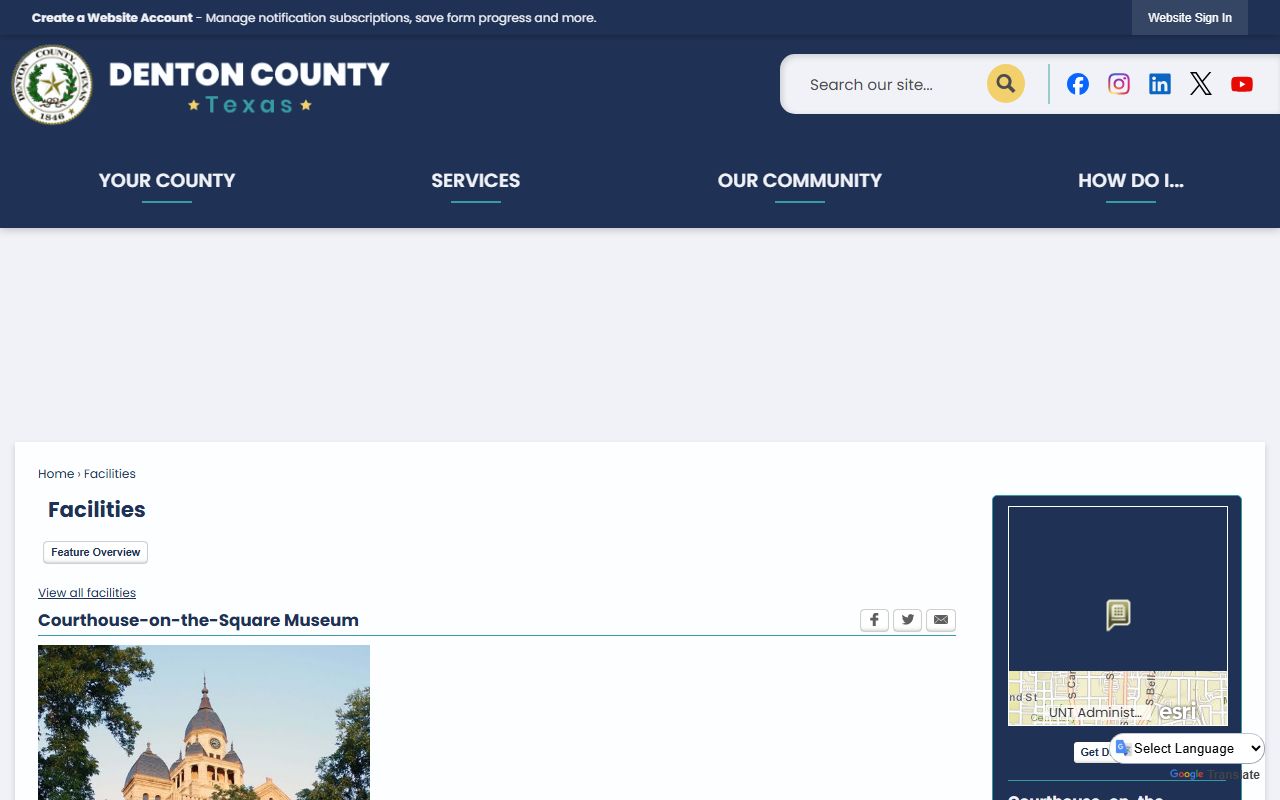
It was restored in 2004 using the original blueprints and built from stone gathered across four Texas regions. Today's cases are filed in modern county buildings, not in the historic courthouse.
Frequently Asked Questions
How do I search Denton County court records online?
Start at the county's Judicial & Law Enforcement Records Search page and pick Denton County Records. That portal covers case records, court calendars, and Sheriff jail and bond records. Use the County Clerk's official records search for marriage and real property. For certified copies, file a request with the District Clerk or County Clerk and pay the fee.
Which clerk handles divorce decrees?
The District Clerk. Divorce is a district court and family-law matter, so the decree sits with that office. Use the Record Request Form with the cause number or party name, the document title, and your chosen copy type. Certified copies cost a $5 certification plus a per-page charge.
Are online court records official?
Not on their own. Denton County warns that displayed records are subject to data-entry limits and that judgment details can be verified only by the actual court file. Use the portal to find and plan, then order a certified copy from the clerk when you need an official document.
More on the Denton County Court Records FAQ page.