
What a Denton County Court Docket Is
Think of a docket as the case timeline. Each time a party files a paper, the clerk logs it. Each time the court sets a hearing, that setting goes on the docket too. The docket is the court's own running record of events in date order. It is not the pleadings themselves. It points to them. A reader uses the docket to see what has happened and what comes next.
Dockets carry the basics. You will see the cause number, the parties, the court, and the dates. You will see entries for motions, orders, and settings. The disposition shows up once the case ends. A motion is a written request asking the judge to order something. A setting is a scheduled court date. A disposition is the outcome, such as dismissed, convicted, deferred, or granted. These three terms come up on almost every docket, so it helps to keep them straight.
- Docket
- The list of filings, hearings, and case events kept in date order.
- Setting
- A scheduled court date for a hearing, trial, or other appearance.
- Disposition
- The case outcome, such as dismissed, convicted, deferred, or granted.
So a docket is part calendar, part log. It shows the path of a case through the court.
Denton County Court Calendars and Where to Find Them
Denton County keeps its public lookup links on the Judicial and Law Enforcement Records Search page. That page is the safest landing spot because it carries the county's own disclaimer and groups the official links in one place. From there, the "Denton County Records" portal is the one that covers case records, court calendars, and Sheriff jail and bond records. Court calendars and dockets both flow through that same portal.
Individual courts publish docket detail too. The 16th District Court page has its own "Court Docket" section. So you can reach settings two ways. You can use the central county portal, or you can open the page for the specific court. The county adds a clear caution worth repeating: records shown are subject to data entry limits, and judgment details can be verified only by the actual court file.
Start at the county hub and pick "Denton County Records." The portal sits behind a session screen, so follow the on-screen prompts once you land. You can read more about case files and copies on the Denton County court records page, since dockets and full records share the same starting point.
How to Find a Denton County Docket
Finding a docket is a short, ordered process. The county portal is the main route, but court pages help when you already know the court. Gather a few details first. A full party name helps. A cause number helps more. A rough date range trims a long list fast. Then work through the steps below.
- Open the county hub at the Judicial and Law Enforcement Records Search page.
- Choose "Denton County Records" to reach case records, court calendars, and jail and bond records.
- Pass the session or acceptance screen by following the on-screen prompts.
- Search by party name or cause number, then filter by court and date.
- Open the case to read its docket entries, settings, and status.
- For a specific court's calendar, open that court's page and use its docket section.
If you need a certified document rather than a calendar view, that is a clerk task, not a portal task. The District Clerk fills district court copy requests with a completed form and a fee.
Denton County District Court Dockets
District courts are the general trial courts. They hear felony criminal cases, family-law matters, and larger civil disputes. Their dockets tend to be the busiest in the county. A felony case can carry many settings before trial, and each one lands on the docket. Family cases add hearings on custody, support, and protective orders. So district dockets often run long.
The 16th District Court is a good example. Its page lists Judge Sherry Shipman at 1450 E McKinney Street, 3rd Floor, Denton, TX 76209, with phone 940-349-2310. The page also carries a "Court Docket" section where settings are posted. Other numbered district courts post their own alerts and settings, including the 158th and 477th District Courts. For a deeper look at how these courts are organized, see the Denton County District Court page.
Important. Denton County district and Justice of the Peace court pages warn that you must not contact a judge about a pending or potential case by mail, email, phone, or in person. This is called ex parte contact, and the courts forbid it. Bring questions about a setting to the clerk, not the judge.
Denton County County Court Dockets
County courts sit a step below the district courts. In Denton County these include the County Courts at Law and the County Criminal Courts. They handle misdemeanor criminal cases, statutory county-court matters, juvenile cases, and other work assigned locally. The county also runs specialty programs such as the Mental Health Treatment Court and the Veterans Treatment Court. Each has its own settings.
The county lists 13 court and program entries on its County Courts page. That set covers County Court Administration, County Court at Law 1 and 2, County Criminal Courts 1 through 5, the Magistrate Court, the two probate courts, and the two treatment courts. Misdemeanor dockets move faster than felony dockets in most cases, but they still log every setting and order. County criminal court dockets often show arraignment dates, plea settings, and trial dates. An arraignment is the hearing where charges and a plea are addressed.
Probate Court No. 1 and Probate Court No. 2 keep their own dockets for estates, guardianships, and mental-health commitments. Those settings sit with the statutory probate courts, not the district courts.
Denton County JP Court Dockets and Case Search
Justice of the Peace courts handle the smallest matters. They take Class C misdemeanors, fine-only traffic, small civil suits, evictions, and bad-check cases. Each precinct keeps its own dockets and posts its own hearing dates. The JP courts also issue arrest orders and search warrants and handle magisterial duties, so their dockets cover a wide mix.
The precincts link their case tools right on their pages. JP Precinct 1 links a "Case Access Portal" under View and Pay Cases Online, and a "Denton County Records Inquiry" link under Hearing and Case Search. JP Precinct 3 posts separate criminal case records search and civil case records search links. So a reader can look up a JP case by precinct and pull its docket and status.
The image below points to that JP Precinct 3 page so you can see those case lookup links in context.
You can open the county page for Justice of the Peace Precinct 3 to reach the criminal and civil case lookups.
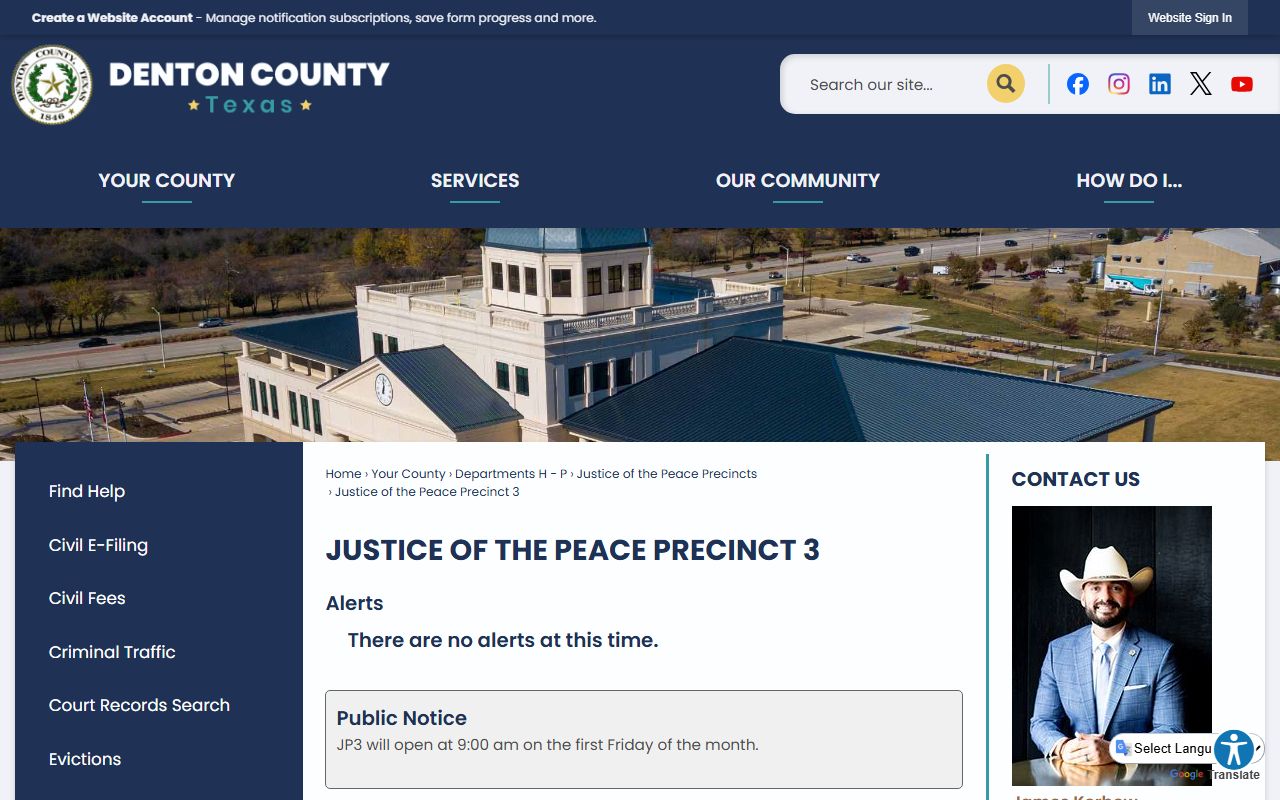
That JP page links straight to the criminal and civil case searches, which is how you reach a precinct docket and its settings. Online JP payment carries warnings: it is for adult defendants only, a payment counts as a plea of no contest, and it may not post until the next business day.
Note: an online JP payment may not recall an outstanding warrant until the payment posts, so check your case status before you assume the matter is closed.
How Dockets Differ From Full Case Records
A docket and a case file are not the same thing. The docket is the index of events. The case file holds the actual papers, like the petition, the motions, the orders, and the judgment. The docket tells you a motion was filed and when. The file holds the motion itself. So a docket is a map, and the file is the territory.
This matters for what you can do with each. A docket is great for checking the next setting or the current status. It is not proof of an outcome on its own. The county says judgment details can be verified only by the actual court records on file. So a docket entry that reads "judgment" still sends you to the file or to a certified copy for the full terms. Public search may help you locate a case, a docket, a jail record, or a bond record, while certified copies still come from the clerk.
For arrest and booking detail tied to a criminal docket, the Denton County arrest records page covers the jail and booking side.
What a Single Denton County Docket Entry Means
Each line on a docket is one event. Read across the line and you get the setting date, the type of hearing, the court, the filing or event, and the result. The cause number anchors the whole case. District examples take forms like F22-1489-362, and the suffix often marks the court number. With that number you can pull the parties, the charge or claim, and the outcome. The table below breaks down a sample docket entry field by field.
| Field | What It Shows |
|---|---|
| Setting Date | The scheduled date for the hearing, trial, or appearance |
| Hearing Type | The kind of setting, such as arraignment, plea, or trial |
| Court | The court hearing the case; a cause-number suffix often marks the court number |
| Filing / Event | The motion, order, or paper logged on that date |
| Result / Status | What happened, such as reset, ruled, or the case disposition |
Bond and jail links may show next to criminal entries, since the same county portal carries Sheriff jail and bond records. A bond is money or a promise that secures release and a future court date. A capias is a warrant-like writ that directs an arrest, often after a missed setting.
Certified Case Status Versus an Online Docket
An online docket is fast and free, but it is informal. A certified record is official. When a case status needs to stand up in a legal proceeding, the online view is not enough. The District Clerk is the right path for district records. The request form asks for the cause number or party name, the document titles and file dates if known, the copy type, and payment. The office notes a 10-business-day processing window.
The County Clerk runs a separate search for recorded instruments and some vital and commissioners records, not district court documents. So pick the office by the record type. District Clerk for district civil, felony, and family case documents. County Clerk for misdemeanor, probate, and recorded official records. The Denton County court records FAQ answers more common questions about which office to use and what a certified copy costs.
In short, use the online docket to track a case. Use a certified copy when you need to prove its status.