
How to Find Recent Denton County Arrest Records
Arrest and booking data in Denton County runs through the Sheriff's Office. The Sheriff books people into the county jail, keeps the records, and posts them to the official portal. The Judicial & Law Enforcement Records Search page is the gateway. From there, "Denton County Records" is the portal that carries Sheriff jail and bond records along with case files and court calendars. The portal sits behind a session screen, so follow the on-screen prompts once you arrive.
The Sheriff is Tracy Murphree. The office is the chief law enforcement agency for the county. It runs the county jails, makes arrests, and holds the booking records that show who was taken into custody and when.
Two link labels matter on the Sheriff Services page. One is "Jail Records Search." The other is "Bond Records Search." Jail records answer a simple question: was this person booked? Bond records answer a different one: what bond was set, and under what case context. Both pull from the same portal environment.
- Open the county hub and choose the Judicial & Law Enforcement Records Search page.
- Select "Denton County Records" to reach jail and bond data.
- Enter the person's name and follow the on-screen search options.
- Open the booking entry to read the charge, booking date, and bond.
- For court history tied to the arrest, switch to the case records search.
For a name that was recently booked, the jail records search is the fastest path. For the case that follows, you move to the court side of the same portal. The Denton County inmate records page covers the live jail roster in more detail.
Presumption of innocence. An arrest or booking record is only an accusation. It records that someone was taken into custody. It does not prove guilt. A person is presumed innocent until a court convicts them, and many arrests never lead to a conviction at all.
Requesting Denton County Arrest Records From the Sheriff
Some arrest and jail information is not on the public portal. For that, you file a public information request with the Sheriff's Office. The Sheriff page is unusually clear about how to do this. The approved methods are limited, and the office expects you to use one of them. Pick whichever fits your situation.
- U.S. mail to the DCSO Records Division at 127 N. Woodrow Lane, Denton, Texas 76205.
- Email to so.orr@dentoncounty.gov.
- Hand delivery to the DCSO Records Division at 127 N. Woodrow Lane.
- Electronic submission through the Sheriff's Office GovQA portal.
These four methods are the ones the Sheriff publishes for an open records request. Sheriff records fall under the Texas Public Information Act, which is different from court case files. So a booking log or an arrest report goes through the Sheriff, while the case that follows goes through a clerk. If you also need fingerprints for a background, adoption, or expunction matter, the law enforcement center takes prints on set days for a small cash fee.
Denton County Sheriff's Office
Law Enforcement Center
127 N Woodrow Lane
Denton, TX 76205-6397
940-349-1600
Arrest Record vs Criminal Court Record in Denton County
People often treat these as the same thing. They are not. An arrest record is created at booking by law enforcement. A criminal court record is created when the case moves into court. One can exist without the other. A person can be arrested and never charged, and a charge can be filed without a fresh arrest. The table below sorts out who holds what.
| Point | Arrest Record | Criminal Court Record |
|---|---|---|
| What it is | A booking entry from the time of arrest | The case file from the prosecution |
| Who holds it | Denton County Sheriff's Office | District Clerk (felony) or County Clerk (misdemeanor) |
| What it proves | That a person was taken into custody | The charge, the plea, and the outcome |
| Where to find it | Sheriff jail and bond records portal | County case records portal and clerk files |
If you want the full picture, you need both. Start with the arrest record for the booking facts. Then pull the case for the disposition. The Denton County court records page walks through that case-file side in full.
Charges vs Convictions in Denton County Records
This is the distinction that trips people up most. A charge is an accusation. A conviction is a finding of guilt by a court. An arrest record almost always shows a charge. It rarely shows the final result, because the result comes later, in court. So reading a charge as a conviction is a common and serious mistake.
| Point | Charge | Conviction |
|---|---|---|
| What it means | A formal accusation of a crime | A court's finding of guilt |
| When it appears | At or near the time of arrest | After a plea or trial |
| Proves guilt | No | Yes |
| Where it shows | Booking and arrest records | Court disposition in the case file |
Texas also has outcomes that sit between the two. Deferred adjudication is one. A person can complete community supervision and avoid a final conviction. Dismissals and acquittals leave a charge with no conviction at all. To know which one applies, you have to read the disposition field in the court file, not the arrest entry.
A few terms help here.
- Disposition
- The case outcome, such as dismissed, convicted, deferred, or granted.
- Deferred adjudication
- A community-supervision outcome that can avoid a final conviction if completed.
- Indictment
- A grand jury's charging instrument for a felony prosecution.
- Plea
- The defendant's response to a charge, such as guilty, not guilty, or no contest.
Note: a dismissal does not automatically erase an arrest, so a record can still show the arrest even after charges are dropped.
Mugshots and What Is Public in Denton County Arrest Records
A booking record can include a mugshot, the booking number, the booking date and time, the arresting agency, the charge, the bond, and basic demographics. The county cautions that displayed records are limited by data entry. Details should be verified against the actual file if a decision rides on them. Public results can also lag, so call the right office if a release, bond, or court setting is urgent.
Not everything is open. Several categories are restricted by law, and a clerk or the Sheriff will not release them on demand.
- Juvenile records, where a child's case usually cannot be viewed online.
- Sealed and expunged criminal records, withheld unless the law allows release.
- Personal identifiers like Social Security and driver license numbers, which are redacted.
- Active investigation material, which can be withheld while a case is open.
So the public side gives you the booking facts. The protected side stays closed unless you have a court order or a legal exception. If a warrant is what sent the person to jail, the Denton County warrant records page explains how those work.
Sealed vs Expunged Denton County Arrest Records
People use these words as if they mean the same thing. They do not, and the difference is large. Expunction can destroy or return records. Nondisclosure only limits who can see them. Both start with a court order, but the effect on the arrest record is very different.
| Point | Sealed (Nondisclosure) | Expunged (Expunction) |
|---|---|---|
| Governing law | Government Code Chapter 411 | Code of Criminal Procedure Chapter 55 |
| Effect on record | Limits public release; record still exists | Orders records destroyed or returned |
| Who can still see it | Criminal-justice agencies and some licensing bodies | Generally no one, once carried out |
| Common path | After certain deferred-adjudication outcomes | Acquittal, pardon, or qualifying dismissal |
Expunction has strict rules. A person files a petition in the proper court and must list every agency that may hold the record, from the arresting agency to the jail to the state. If the court grants it, those agencies may be ordered to return, destroy, or delete what they hold. Eligibility depends on the outcome, such as an acquittal, a pardon, a dismissal that qualifies, or a case of mistaken identity.
Nondisclosure is the lighter remedy. It limits public dissemination of certain criminal-history information after qualifying outcomes. The record stays in government hands and can remain visible to criminal-justice agencies. The Denton County District Clerk handles expunction issuance request forms and lists local agency contacts for these cases.
Felony and Misdemeanor Records Tied to a Denton County Arrest
Once an arrest becomes a case, the records split by court. Felonies go to district court, and the District Clerk is the custodian of those files. Misdemeanors go to the county criminal courts, and the County Clerk keeps those. So the office you contact depends on the level of the charge, not just the arrest.
For felonies, the District Clerk offers a felony case record search for $5 per search and certificate. That search is limited to Denton County district files. It is not a statewide or national background check. For misdemeanors, the County Clerk holds the records for County Criminal Courts 1 through 5. Fines and misdemeanor payments link from the County Clerk's filing and cost pages.
A district cause number often points to the court. Felony examples take forms like F22-1489-362, where the suffix tends to mark the court number. With that number, you can pull the parties, the charge, and the disposition from the case file. The broader case history lives on the court records page rather than in the arrest entry.
State Criminal History Sources Beyond Denton County
County records only show Denton County. For a wider criminal history, the state is the better source. The Texas Department of Public Safety runs the Crime Records division, which maintains the statewide criminal history repository. That is a different file from anything the county holds, and it pulls from agencies across Texas.
The Texas DPS Crime Records division is the state's hub for criminal history record information.
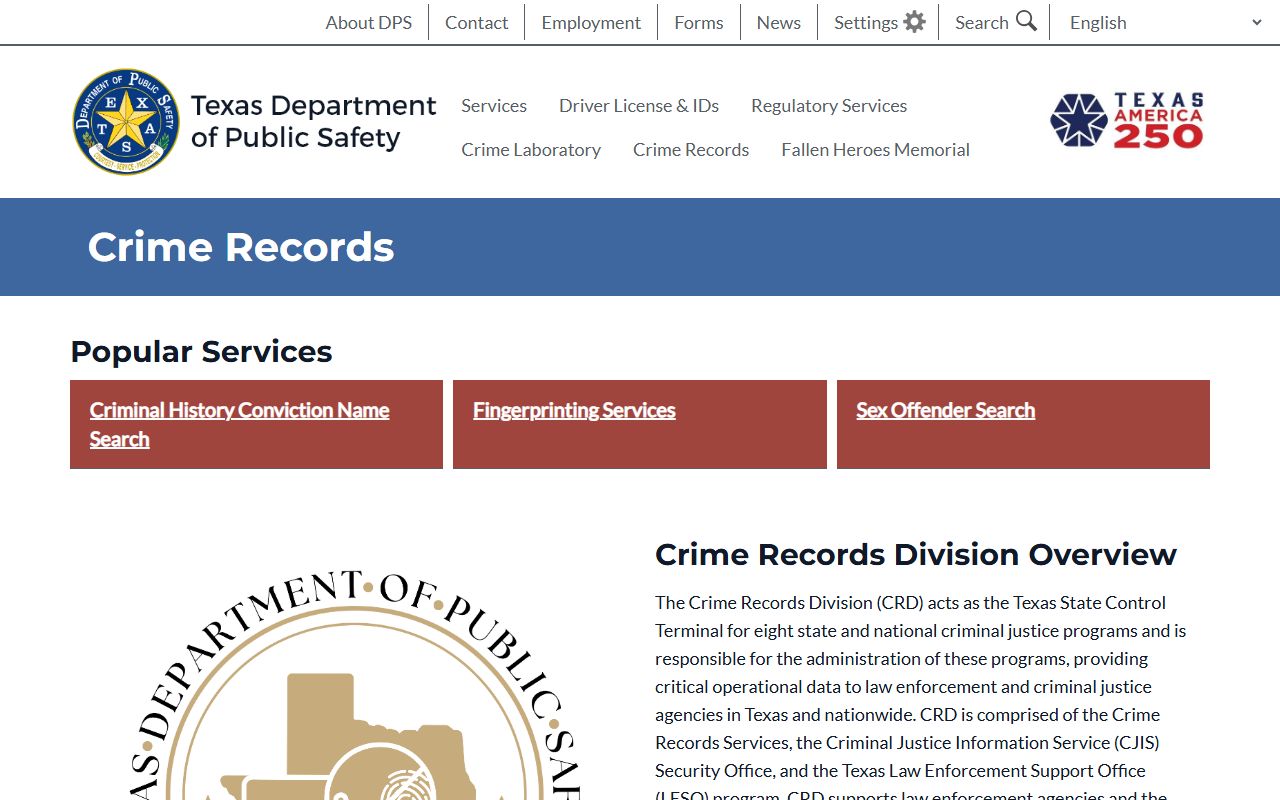
A DPS criminal history search reaches beyond Denton County, so it can show arrests or cases from other Texas counties that a county portal would miss.
There is also a public registry that anyone can search. The state maintains a sex offender registry that is open to the public and separate from the county court system. It lists registered offenders by name and location and is not the same as an arrest or booking record.
You can search the Texas public sex offender registry by name or area.
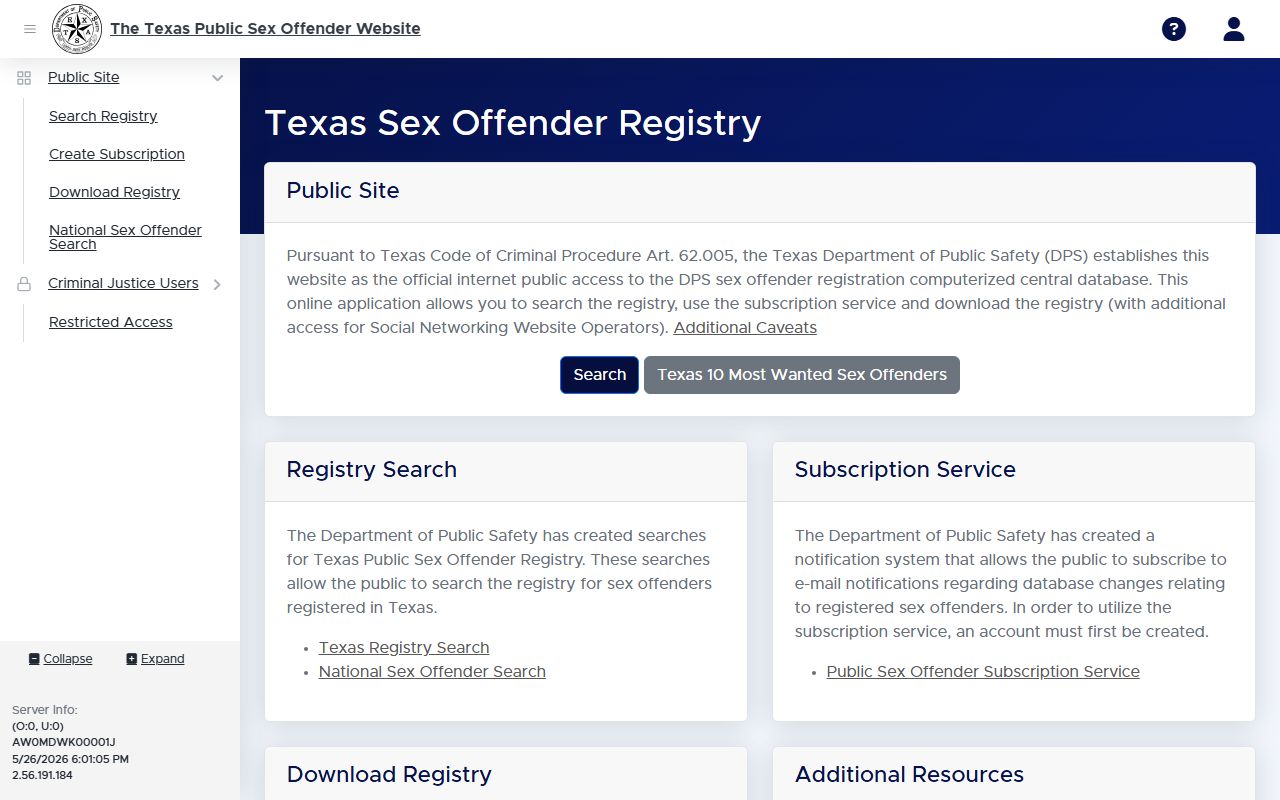
The registry is a state tool, so use it alongside, not instead of, the Denton County jail and court records when you build a full background.
Using Denton County Arrest Records for Background Checks
A single county search is rarely a complete background. The District Clerk felony search covers Denton County only. The County Clerk covers Denton County misdemeanors only. Neither one reaches other counties, and neither is a federal check. To get a fuller view, you combine the county sources with the state DPS repository.
There are limits on how arrest data can be used. An arrest is not a conviction, and treating it as one can be both unfair and unlawful in some settings. Federal and state law govern how records get used for credit, employment, housing, and similar decisions. A public-records lookup is for general information, not for screening that the law regulates.
Note: a county portal search and a certified record are different, and only a certified copy from the clerk is accepted for formal legal use.
Who Prosecutes Denton County Arrests
After an arrest, the case goes to the prosecutor. In Denton County that is the Criminal District Attorney, identified in county records as the chief prosecuting officer responsible for receiving cases. The office decides whether to file charges, what to file, and how to move a case forward. The Sheriff makes the arrest, but the District Attorney runs the prosecution.
The office also serves crime victims. Its Victims' Assistance Division helps people navigate the criminal justice system and can be reached at 940-349-2600. A Director of Victim Services leads that work. If you were the victim in a Denton County case, that division is the contact point for case updates and support.
In late 2025, the District Attorney's role drew local attention. On October 23, 2025, CBS Texas reported that three Denton police officers were indicted for alleged criminal conduct tied to the arrest of a homeless individual, according to the Denton County District Attorney's Office. It is a reminder that arrests and prosecutions cut in more than one direction.
The CBS Texas report on the Denton police indictments covers the case and the District Attorney's role in it.
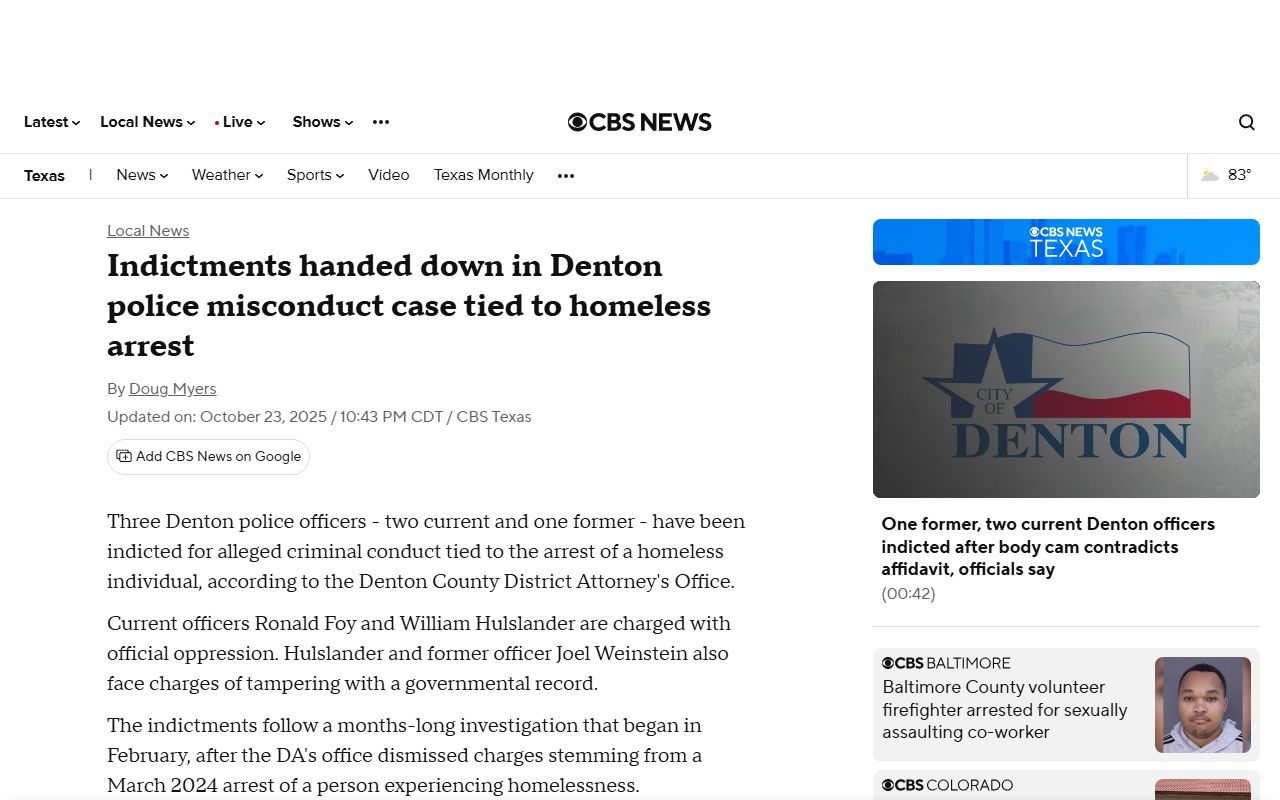
The indictments came from the same prosecutor's office that handles routine arrest cases, which shows how arrest and court records connect across a single county system.