
How to Search Denton County Traffic Court Records
The first step is the right precinct. Justice of the Peace courts in Denton County run their own case lookup and payment tools. JP Precinct 1 offers case access through a Denton County Records Inquiry along with e-filing. JP Precinct 3 runs a payment portal that lets you check a case and pay a ticket. To find a ticket fast, you need three things. You need the precinct number, the citation or cause number, and the amount due. Each appears on the paper citation or the court notice you were given.
Start at the precinct that handles your stop. If you are not sure which one, the county lists a phone number for each of the six precincts. Call and ask before you pay anything.
- Read your citation for the JP precinct number and the docket or cause number.
- Open that precinct's case access or payment portal, or call the precinct.
- Enter the precinct, the cause number, and the amount to confirm the case.
- Review the charge, the offense date, and the status before you act.
- Decide whether to pay, appear, post bond, or set a court date.
City tickets follow a different path. A citation written inside a city goes to that city's municipal court, not a JP court. The image below shows the county's Justice of the Peace tickets page, which is the main hub for JP citation and payment links.
The county's Justice of the Peace Tickets page gathers the JP ticket and payment links in one place.
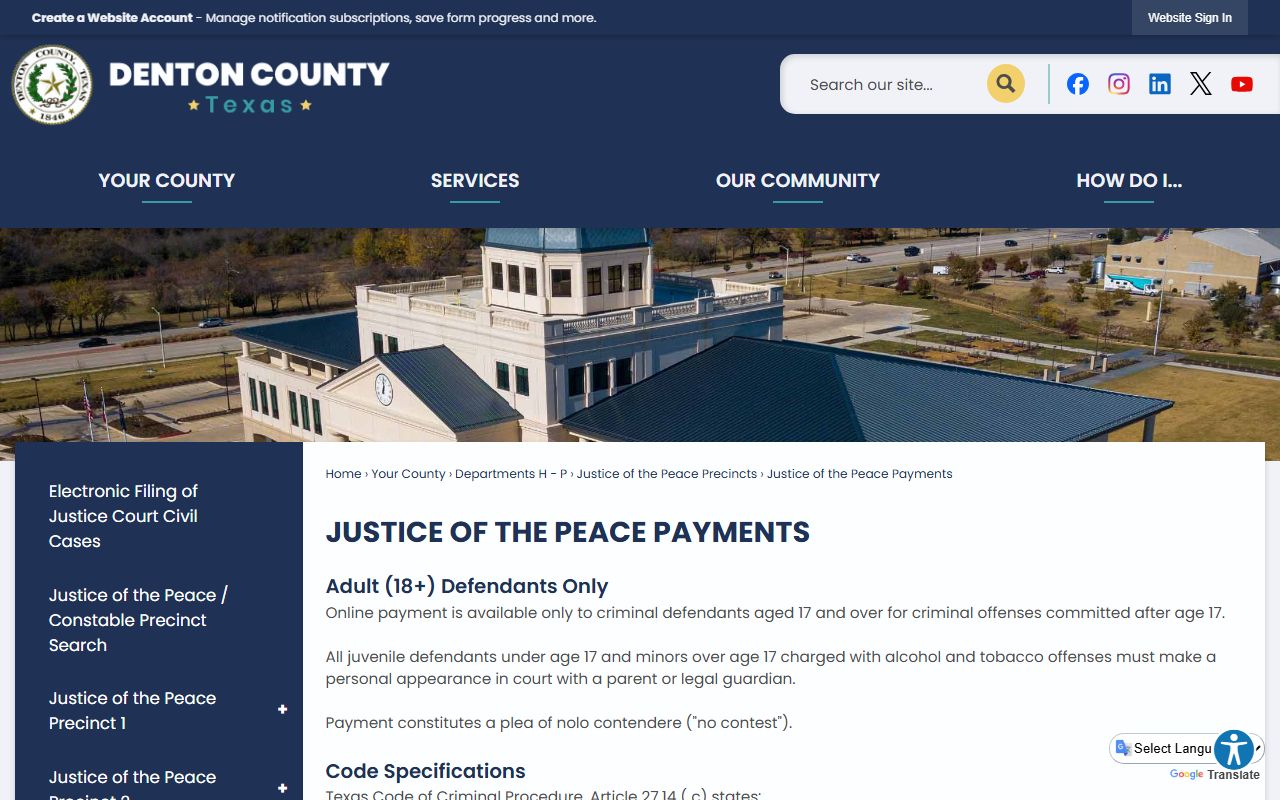
From there you reach the precinct portal that matches the court named on your Denton County traffic citation.
Which Courts Handle Traffic Cases in Denton County
Two kinds of courts handle traffic in Denton County. Justice of the Peace courts take citations written outside city limits. Municipal courts take citations written inside a city. The agency that wrote the ticket points you to the court. When a State Trooper, a Game Warden, or a County Deputy issues a citation, that ticket is handled in a Justice of the Peace court. When a city police officer writes a Class C ticket inside the city, it goes to that city's municipal court instead.
The City of Denton Municipal Court handles Class C matters that arise inside the City of Denton. Other cities in the county run their own municipal courts the same way. So a speeding ticket on a state highway and a speeding ticket on a city street can land in two very different courts.
Denton County has six JP precincts. Each keeps its own citation, eviction, and small civil files. If a ticket is not paid or resolved with the JP court, the judge can issue a warrant for arrest, and in Denton County those JP warrants go to the Constable's office to serve. You can read more about that on the warrant records page and the Justice of the Peace courts page.
Types of Denton County Traffic Cases on Record
Most traffic cases are fine-only Class C misdemeanors. These are the lowest level of criminal case in Texas, and a JP or municipal court hears them. Speeding, running a light, no insurance, and seat-belt tickets all fall in this group. The fine is the main penalty. There is no jail time for a simple Class C traffic offense.
JP courts also hear other fine-only matters that are not strictly traffic. The list is broader than many drivers expect.
- Fine-only Class C traffic citations, such as speeding or failure to yield.
- Parks and Wildlife violations, like a fishing or hunting rule break.
- Bad-check and truancy cases handled at the JP level.
- Other Class C offenses written by a trooper, deputy, or game warden.
City ordinance tickets are separate again. Those go through the municipal court for the city that wrote them. A handful of traffic-linked cases climb higher, and those move out of the JP and city courts entirely.
What Denton County Traffic Court Records Show
A traffic court record is a set of fields the court enters as the case moves. The citation number ties it together. With the cause or docket number, you can pull the charge, the date of the offense, the fine, and how the case ended. The table below lists the fields a Denton County traffic record commonly shows. These mirror the case fields used across the county's court records and request forms.
| Field | What It Shows |
|---|---|
| Citation Number | The number printed on the paper ticket by the officer |
| Cause / Docket Number | The court's case identifier for the ticket |
| Precinct / Court | The JP precinct or municipal court that holds the case |
| Charge / Violation | The traffic or Class C offense charged |
| Offense Date | The date the stop or violation took place |
| Fine / Amount | The amount due, plus court costs and any fees |
| Status / Disposition | Open, paid, dismissed, or other case outcome |
The portal may not show every detail. The county warns that displayed records are limited, and that real case detail comes from the actual court file. For a felony or larger case, that detail lives with the District Clerk, not a JP court. See the court records page for those files.
Searching by Citation Number vs by Name
You can search a traffic case two ways. The citation or cause number is the fastest. It points to one case with no guessing. If you have the paper ticket or a court notice, read the number off it and use that. The JP payment tools are built around the cause or docket number and the precinct.
A name search is the fallback. Use it when the ticket is lost or the number is missing. A name can return more than one match, especially for a common name, so you may need a date or the precinct to narrow it. The county also cautions that records are tied to data entry, so a fresh ticket may not appear right away. When the number search and the name search both come up short, call the precinct directly. The clerk can confirm whether a case exists and read you the balance over the phone.
Paying or Contesting a Denton County Traffic Ticket
To pay a Denton County ticket online, the JP system asks for a small set of details. You need the JP precinct number from the citation, the amount to pay, and the docket or cause number. An email address is optional and is used for a receipt. The portal takes Visa, MasterCard, and Discover. It does not take American Express. The table below lists the citation lookup and payment fields drawn from the county's JP payment portal.
| Field | Required | Notes |
|---|---|---|
| JP Precinct Number | Yes | Must match the citation or civil document. |
| Amount to Pay | Yes | The amount due on the case. |
| Docket / Cause Number | Yes | Needed to process the payment. |
| Email Address | No | Used to send a receipt. |
| Payment Card | Yes, if paying online | Visa, MasterCard, Discover; no American Express. |
A 2.75% processing fee is added to card payments. Timing matters too. A payment is not processed until the next business day. If a warrant is out, it may not be recalled until the payment posts. So do not assume a ticket is cleared the moment you hit pay.
Important. Paying a fine-only ticket counts as a plea of no contest. Under Code of Criminal Procedure Article 27.14(c), payment in a fine-only misdemeanor is a finding of guilty in open court and waives a jury trial, so it can become a conviction on your record.
If you want to fight the ticket instead, do not pay it. Follow these steps to handle a Denton County traffic ticket the right way.
- Find the correct JP precinct or municipal court from the citation.
- Confirm the cause number, the charge, and the total balance.
- Ask whether jail credit applies if you were recently in jail.
- Decide whether to pay, appear, post bond, or set a court date.
- If contesting, request a court date and keep all paperwork.
- Keep the receipt and confirm any warrant recall after the payment posts.
Public Access Laws for Denton County Traffic Court Records
Traffic court records are generally public, but parts can be hidden. County administrative records fall under the Texas Public Information Act, Government Code Chapter 552. Court case files follow court rules instead, under Government Code Section 552.0035 and Rule of Judicial Administration 12. So a traffic case is reached through the court, not a public-information request.
One statute matters most for tickets. Government Code Section 552.130 covers motor vehicle records. Driver-license and vehicle information inside a citation, crash report, or court exhibit may be redacted even when the case itself is public. So a public traffic record can still hide a license number or a plate. Clerks also mask Social Security numbers and financial account numbers under other parts of the Act. You can read the law through the Texas Government Code Chapter 552 text and the judicial side through the Texas Judicial Branch Rule 12 policy.
Court Traffic Records vs State Driver Records
People mix up these two files, and the difference matters. A court traffic record is the case at the JP or municipal court. A state driver record is your driving history held by the state. They are not the same file, they live in different places, and you fix errors in each one a different way. The City of Denton Municipal Court, shown below, is one example of where the court side of a city ticket lives.
The City of Denton Municipal Court handles Class C citations written inside the City of Denton.
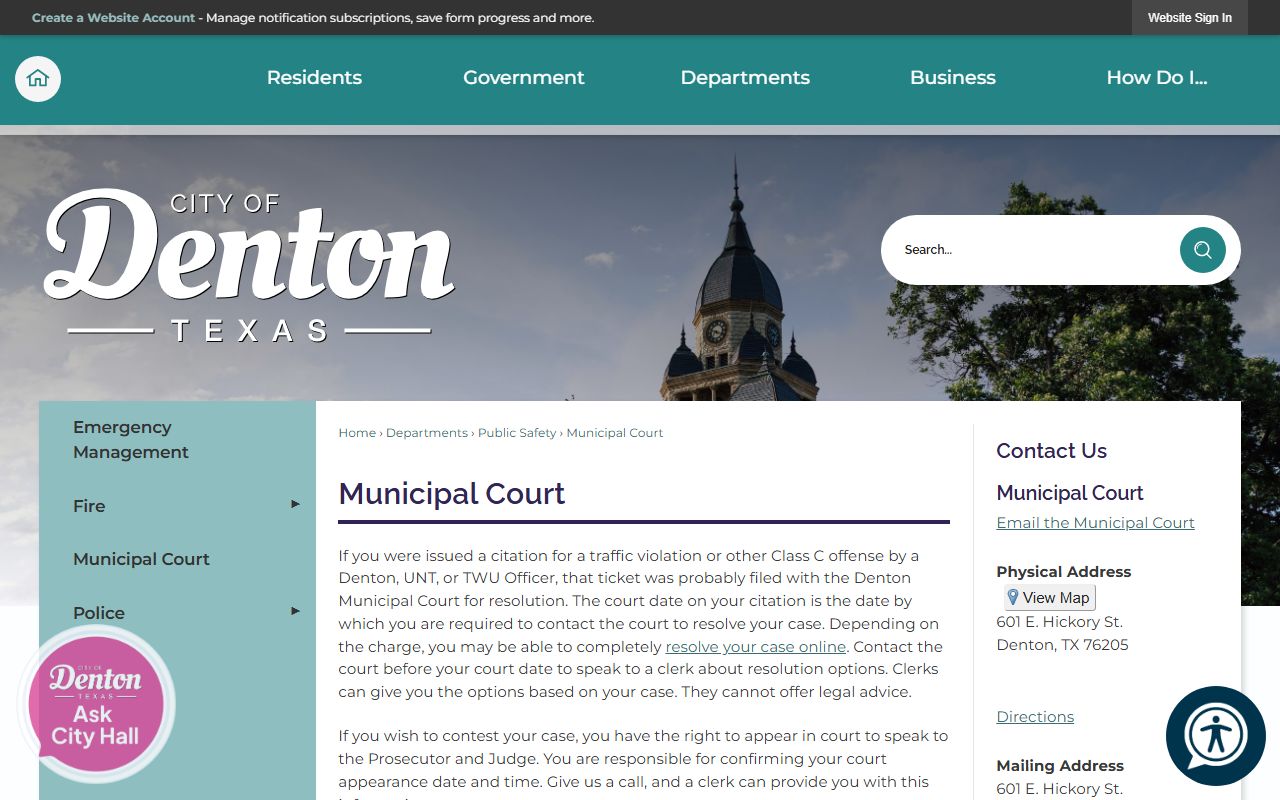
The municipal court page handles the case, not your statewide driving history. The table below lays out how the two records compare.
| Court Traffic Record | State Driver Record | |
|---|---|---|
| Record source | The JP or municipal court that holds the ticket | The Texas DPS / DMV driver record system |
| What it contains | The case: citation, charge, fine, and disposition | Your driving history, points, and license status |
| Where to access it | The precinct case portal or the municipal court | The state DPS / DMV, not the county court |
| How to correct an error | Through the court that holds the case | Through the state agency that holds the driver record |
So a ticket can be closed at the court yet still show up on your driving record, or the other way around. Check both if the result matters for insurance or a license. Note: motor-vehicle details on a court traffic record may be redacted under Government Code Section 552.130 even when the case is public.
CDL and Commercial Driver Records
Commercial drivers face stricter rules. A holder of a commercial driver license cannot take deferred adjudication to mask a traffic violation. The path that lets many drivers keep a ticket off the record is closed to a CDL holder. So the same speeding ticket can hit a commercial driver harder than a regular driver.
This is why a CDL holder should think hard before paying or pleading. A conviction can affect the license and the job behind it. The court file and the state driver record both come into play here, and the two do not always match. When a CDL is on the line, it is wise to talk to a lawyer before you act on a Denton County traffic citation.
DUI / DWI Cases
A DWI is not a fine-only traffic case. It is a criminal charge, and it does not stay in JP or municipal court. These cases move up to the county criminal courts or district court, and the records sit with the clerk there, not the JP precinct. For booking, charges, and case history on a DWI, use the arrest records page, which routes you to the right criminal file.
Deferred Adjudication and Defensive Driving for Denton County Tickets
Texas gives most drivers a way to keep a ticket off the record. Deferred adjudication is a short period of court supervision. If you finish it without a new problem, the case can avoid a final conviction. A defensive driving course is another route. Many JP and municipal courts let you take an approved course to dismiss a single Class C traffic ticket, often with a fee and proof of a valid license and insurance.
Ask the court first. Each precinct sets its own steps and deadlines, and not every ticket qualifies. A commercial driver cannot use deferred adjudication to hide a violation, as noted above. For a regular driver, though, these options can mean the ticket never lands as a conviction. Get the rules from the court that holds your case before the deadline passes.
Sealing or Expunging Traffic Records
A traffic record can sometimes be cleared, but the bar is set by law. Expunction under Code of Criminal Procedure Chapter 55 can order agencies to destroy eligible records. A dismissal or an acquittal may open the door, while a conviction usually does not. Nondisclosure is different. It limits who can see a record, but the record is not destroyed and stays visible to some agencies.
The rules are strict, and the steps involve the court, the clerk, and the state. A dismissal alone does not erase a record on its own. If a traffic case affects a license, a job, or a CDL, a lawyer can tell you whether expunction or nondisclosure is even an option for your case.
Fees for Denton County Traffic Record Copies
An online lookup is free. A certified or paper copy is not. JP courts handle their own copy requests, and a fee may apply. For a court record copy where the District Clerk is the custodian, the county copy fees below give a clear guide to what a paper or certified copy costs in Denton County.
| Item | Amount |
|---|---|
| Plain paper copy | $1.00 per page |
| Plain electronic copy | $0.10 per page ($1 minimum) |
| Certified paper copy | $5 certification plus $1 per page |
| Certified electronic copy | $5 plus $0.10 per page ($1 minimum) |
Card payments at the JP payment portal carry a 2.75% processing fee on top of the amount due. Note: these copy amounts reflect District Clerk copy fees, so a JP or municipal court may set its own fee for a citation copy. Call the court that holds the ticket to confirm the exact cost before you request a copy.