
The Texas Public Information Act in Denton County
Government records held by Denton County offices fall under the Texas Public Information Act, found in Government Code Chapter 552. Openness is the default rule. The Act sets a clear policy: each person is entitled to complete information about the affairs of government and the official acts of public officials, unless the law says otherwise. That policy lives in Section 552.001, and it shapes how every exception is read. When a record is not clearly closed by law, the lean is toward release.
Section 552.021 creates the actual right of access. It says public information held by a governmental body must be made available during normal business hours. So a county department cannot simply ignore a proper request. If the office wants to hold information back, the path is not silence. The body must, in most cases, ask the Texas Attorney General for a ruling before it withholds. That gives the requester a check. You can press for that review when an office claims a record is exempt and no prior determination already covers it.
The Act mainly reaches administrative and county records. Sheriff files, expense reports, policies, and similar materials sit squarely inside it. Court case files are a different animal, and the next section explains why.
Note: openness under the Act is the rule, and the law tells officials to read exceptions narrowly rather than broadly when they want to keep something private.
Judicial Records Versus County Records in Denton County
Not every Denton County public record runs through the same door. The Public Information Act covers administrative and county-department records. It does not cover the judiciary the same way. Government Code Section 552.0035 says access to judiciary information follows rules adopted by the Texas Supreme Court and other applicable law, not the ordinary Act process. That single line is why a court case file is handled by the clerk, not by a public-information request.
Rule of Judicial Administration 12 is the rule people most often confuse. Rule 12 gives the public access to certain records a judicial agency makes or keeps in its regular course of business that do not pertain to its adjudicative function. In plain terms, Rule 12 can reach a judge's administrative paperwork. It does not govern the case file itself. A pleading, an order, or a docket sheet is part of the court's adjudicative work, so it moves through the clerk and the court-record process instead.
One more point matters. Texas court records should not be called "FOIA" records. FOIA is the federal Freedom of Information Act, and it applies to federal agencies, not to a Texas county or a state court. Local records here follow the Texas Public Information Act, and case files follow court rules. The Texas Judicial Branch keeps its open-records policy online, and a quick look at it makes the split clearer.
The Texas Judicial Branch publishes its Rule 12 open-records policy for administrative judicial records. The screenshot below shows that policy page.
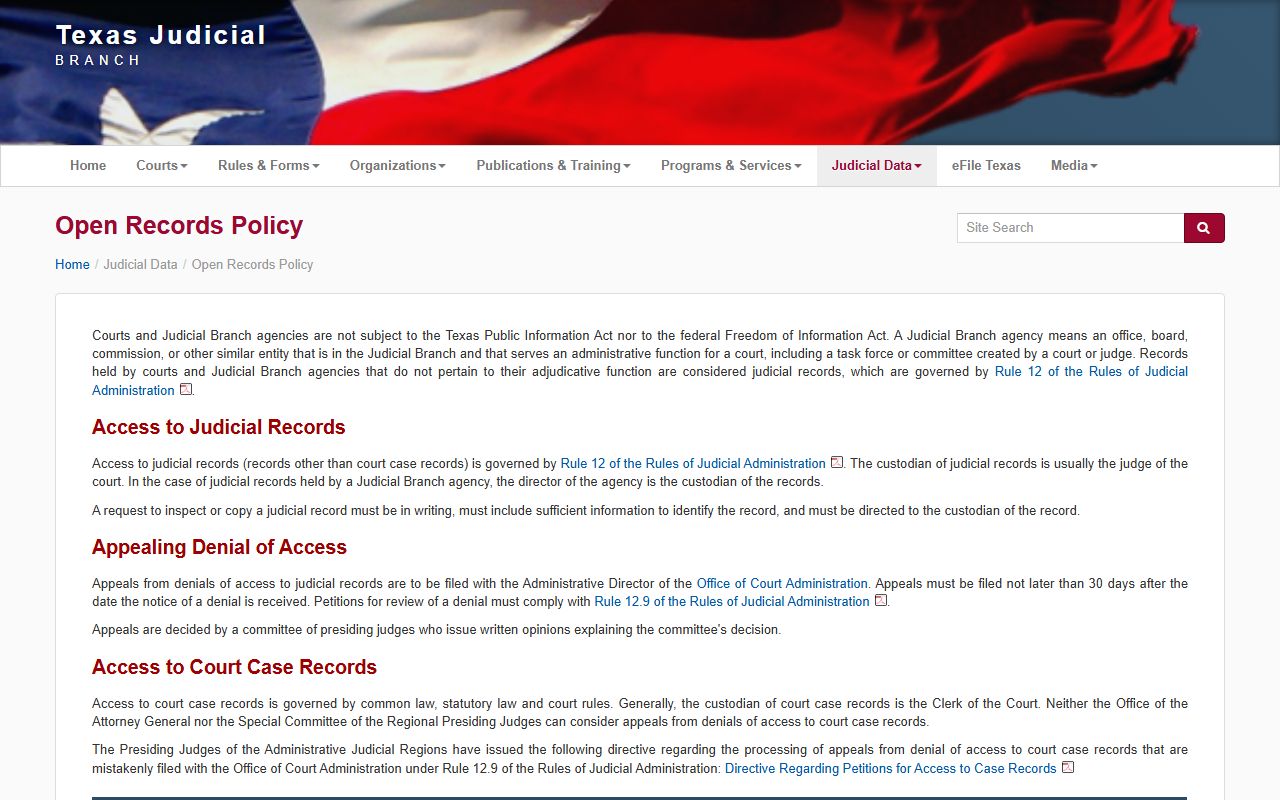
Use Rule 12 for a court agency's administrative files, but pull an actual Denton County court case through the clerk, as the court records page describes.
Denton County Sheriff Public Information Requests
The Denton County Sheriff's Office is unusually clear about how it takes a public information request. The Sheriff page lists only a handful of approved methods, and a request sent any other way may not be processed. Sheriff records can include arrest and jail material that falls under the Public Information Act, so the office routes these through its Records Division. Matching the method to the office is the whole game here.
The only approved ways to file a Denton County Sheriff public information request are these four:
- U.S. mail to DCSO Records Division, 127 N. Woodrow Lane, Denton, Texas 76205.
- Email to so.orr@dentoncounty.gov.
- Hand delivery to the DCSO Records Division at 127 N. Woodrow Lane.
- The GovQA portal, the Sheriff's Office online open-records system.
Pick one method and give clear detail. Name the record, a date range, and any case or report number you have. The more specific the request, the faster the office can find it. A vague ask slows everything down. Keep in mind that an active investigation may be withheld under the law-enforcement exception, which the redaction section below covers.
Note: arrest and jail records are not proof of guilt, so treat a booking entry as a record of a moment, not a final outcome of any Denton County case.
County Clerk Official Records in Denton County
The Denton County Clerk is the official record keeper for a long list of public documents. The office holds Real Property, Vital Statistic, Civil Court, Misdemeanor Court, Probate Court, and Juvenile Court records. For most people, the County Clerk is the place to find deeds, plats, liens, and other recorded instruments tied to property. Marriage records also live here. So do many of the documents people think of first when they say "public records."
County Clerk Administration sits at 1450 E McKinney Street in Denton, and the office runs an online official records search for recorded documents. You can look up real property by grantor or grantee name, by subdivision, by document type, or by document number. The search is free to run, though certified copies carry a fee. Recorded instruments are open to the public, which is why a deed search rarely needs a formal written request at all. You just search it.
Property and recorded records are only part of the picture, and the County Clerk handles a wide set of filings beyond the courts. For a full breakdown of what this office records and how to order certified copies, the County Clerk page goes deeper. That page also covers marriage records and vital statistics in more detail.
District Clerk Record Requests in Denton County
The Denton County District Clerk keeps the district court files. That means felony criminal cases, civil suits, and family or divorce matters heard in district court. The District Clerk is the registrar and custodian of all pleadings and papers that are part of any cause in those courts. To get copies of a district court document, you do not file a Public Information Act request. You use the office's own Record Request Form.
The rule on the form is firm. The District Clerk will not perform a record request, or research about one, without a completed Record Request Form. The form may be submitted in person, mailed to P.O. Box 2146 in Denton, faxed, or emailed to the District Clerk records address. On the form you list the cause number, the party name, the document title, the date the document was filed, and the copy type you want. Give enough detail to pin down the exact file. A thin request gets bounced back.
The office covers only the District Courts of Denton County. It does not keep records for other county departments or for City of Denton matters like zoning, permits, or code violations. So send a city or county-department request to the right office instead. The District Clerk page lays out the full form and its fields.
How to File a Denton County Public Records Request
Filing a request goes smoothly when you follow a clear order. The first job is always to figure out which record you want and which office holds it. After that, the method and the form follow naturally. Below is the path most Denton County public records requests take from start to finish.
- Identify the record and the office that holds it. The Sheriff keeps arrest and jail files, the County Clerk keeps deeds and marriage records, and the District Clerk keeps district court documents.
- Use that office's required method or form. The Sheriff takes mail, email, hand delivery, or the GovQA portal. The District Clerk takes only its Record Request Form.
- Describe the records clearly. Give a name, a case or document number, a title, and a date range so the office can find the exact file.
- Provide ID and payment if the office requires it. Some forms ask for a valid state ID, and certified copies carry a fee.
- Wait the response window. County offices respond under the Public Information Act timeline, and the District Clerk asks for up to ten business days.
- Appeal to the Attorney General if a record is withheld. When an office wants to hold information back, you can press for the Attorney General review the Act allows.
Most requests never reach step six. They get answered. But knowing the appeal exists keeps an office honest when it claims an exemption.
Fees and Processing Time for Denton County Records
Running an online search costs nothing. Getting an official copy does. The Denton County District Clerk publishes its copy fees right on the Record Request Form, and those rates give a good sense of what county records cost across offices. A certified copy adds a flat certification charge on top of the per-page rate, because the clerk is swearing the copy is true. Plain copies skip that step and cost less.
| Item | Amount |
|---|---|
| Plain paper copy | $1.00 per page |
| Plain electronic copy | $0.10 per page ($1 minimum) |
| Certified paper copy | $5 certification plus $1 per page |
| Certified electronic copy | $5 certification plus $0.10 per page |
Plan for the wait. The District Clerk asks you to allow up to ten business days for a request to be completed and mailed. Paper copies go out by first-class USPS mail unless you pick them up in person. Electronic copies are emailed, and the form takes one email address per request. The office does not accept personal checks. Cash, money order, or a card all work, though cards carry a small processing fee.
Sealed documents are a separate matter. The clerk will not release a sealed record unless the law allows it, no matter what fee you offer.
Redactions and Confidential Information in Denton County Records
Open does not mean everything. Several parts of the Public Information Act let an office withhold or black out information even when the record itself is public. The broadest is Section 552.101, which protects information made confidential by other law, a court decision, or the constitution. So when another statute closes a record, this section is the hook that keeps it closed in a public records response.
Law enforcement gets its own shield. Section 552.108 can let the Sheriff or a prosecutor withhold material tied to an active investigation or a pending prosecution, often until the case reaches a final outcome. Personal data is guarded too. Sections 552.117 and 552.147 cover home addresses, phone numbers, family details for protected workers, and Social Security numbers. Motor-vehicle and driver-license information may be redacted under Section 552.130, which matters for crash reports, citations, and court exhibits. Card and account numbers are blacked out under Section 552.136, so payment fields on a clerk form never end up in a public copy.
A useful statute set keeps these rules at hand:
Key statutes:
- Government Code Chapter 552 sets the whole Public Information Act and makes open records the default.
- Government Code Section 552.021 creates the public right to inspect records during business hours.
- Government Code Section 552.101 withholds information that other law makes confidential.
- Government Code Section 552.130 allows redaction of driver-license and motor-vehicle information.
- Rule of Judicial Administration 12 governs a judicial agency's administrative records, not case files.
The official statute portal carries the full text of each section, so you can read the exact wording for yourself. The image below shows that portal.
The official Texas statutes portal hosts every Government Code section in full. The screenshot below shows the search page.
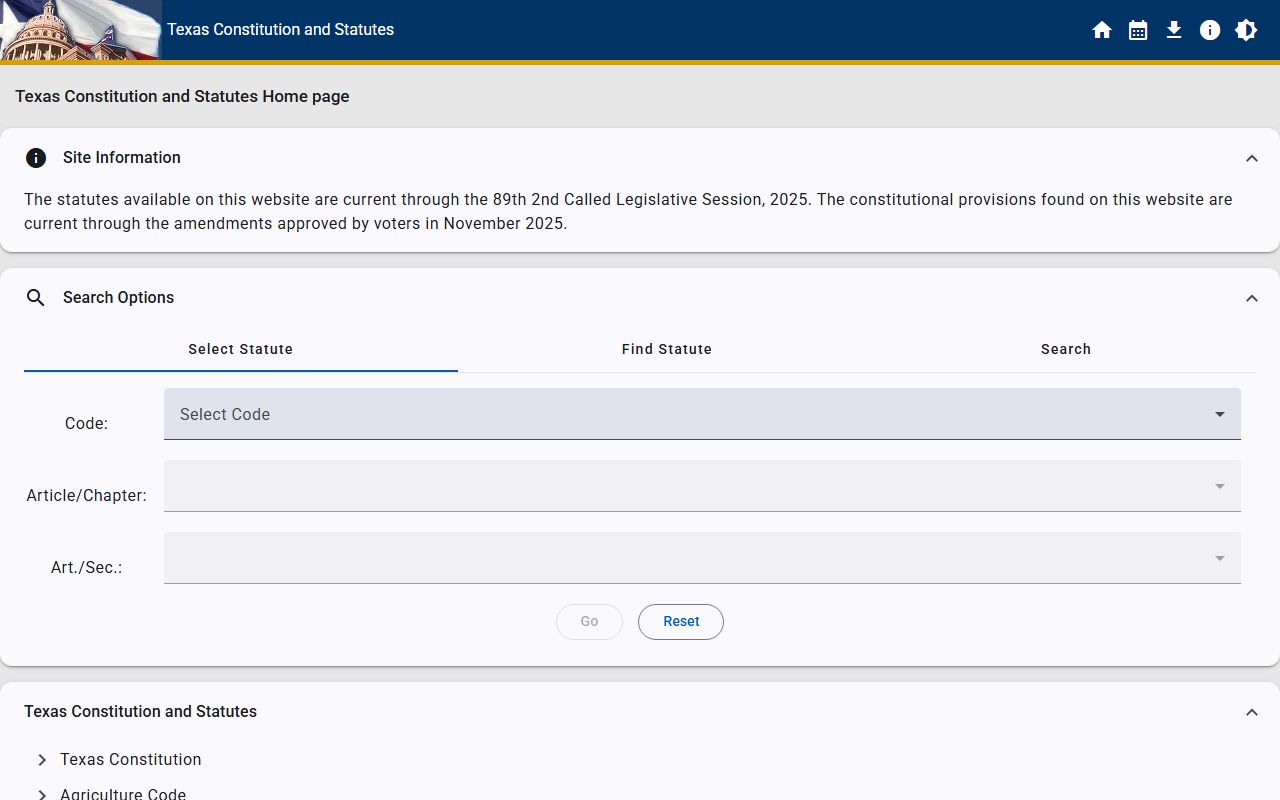
Look up any cited section there before you assume a Denton County record is open or closed.
Note: a clerk can redact a Social Security number or a card number from a public copy and still release the rest of the document under the Act.
DPS, TDCJ, and Federal Records Beyond Denton County
Some records you want are not held by Denton County at all. Statewide criminal history sits with the Texas Department of Public Safety. DPS keeps the state conviction database, and a name-based or fingerprint-based search there reaches beyond any single county. The District Clerk's own felony search is limited to Denton County records, so DPS is the path when you need a statewide criminal history check rather than a local file.
State prison records are separate again. The Texas Department of Criminal Justice, or TDCJ, holds offender information for people in state prison, including custody and parole data. A Denton County jail booking is short-term and local. A TDCJ record reflects a state sentence. Some TDCJ inmate information is shielded by Government Code Section 552.134, though the law also opens specific categories like deaths in custody. For more on local jail and arrest files, the arrest records page covers the Sheriff side.
Federal cases are a third track. Denton County sits in the Eastern District of Texas, Sherman Division, for federal court purposes. Federal civil, criminal, and bankruptcy filings are reached through PACER, the federal case-access system, rather than any county portal. Registration and per-page fees there are federal. The image below shows the PACER access site.
Federal case documents come from PACER, the official federal court records system. The screenshot below shows the PACER homepage.
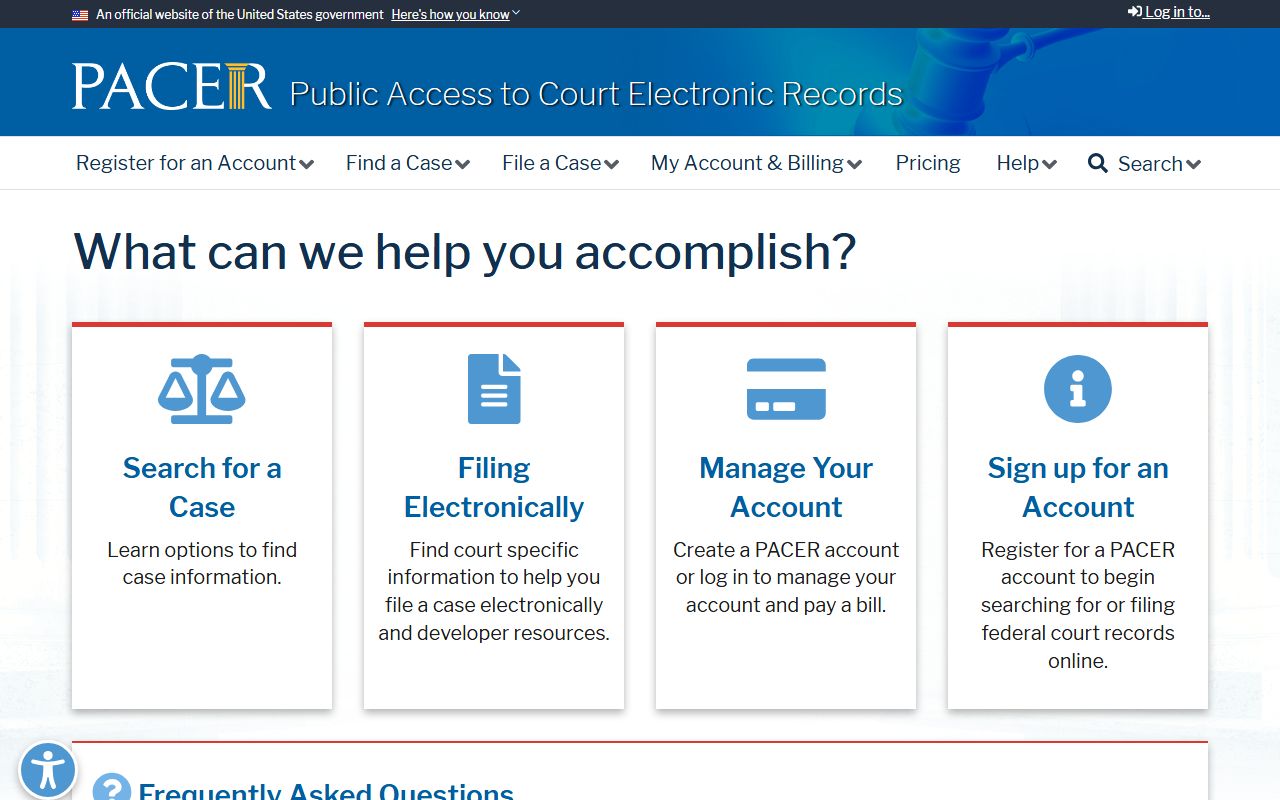
Use PACER for an Eastern District of Texas federal case, but keep county and state requests with their own offices.
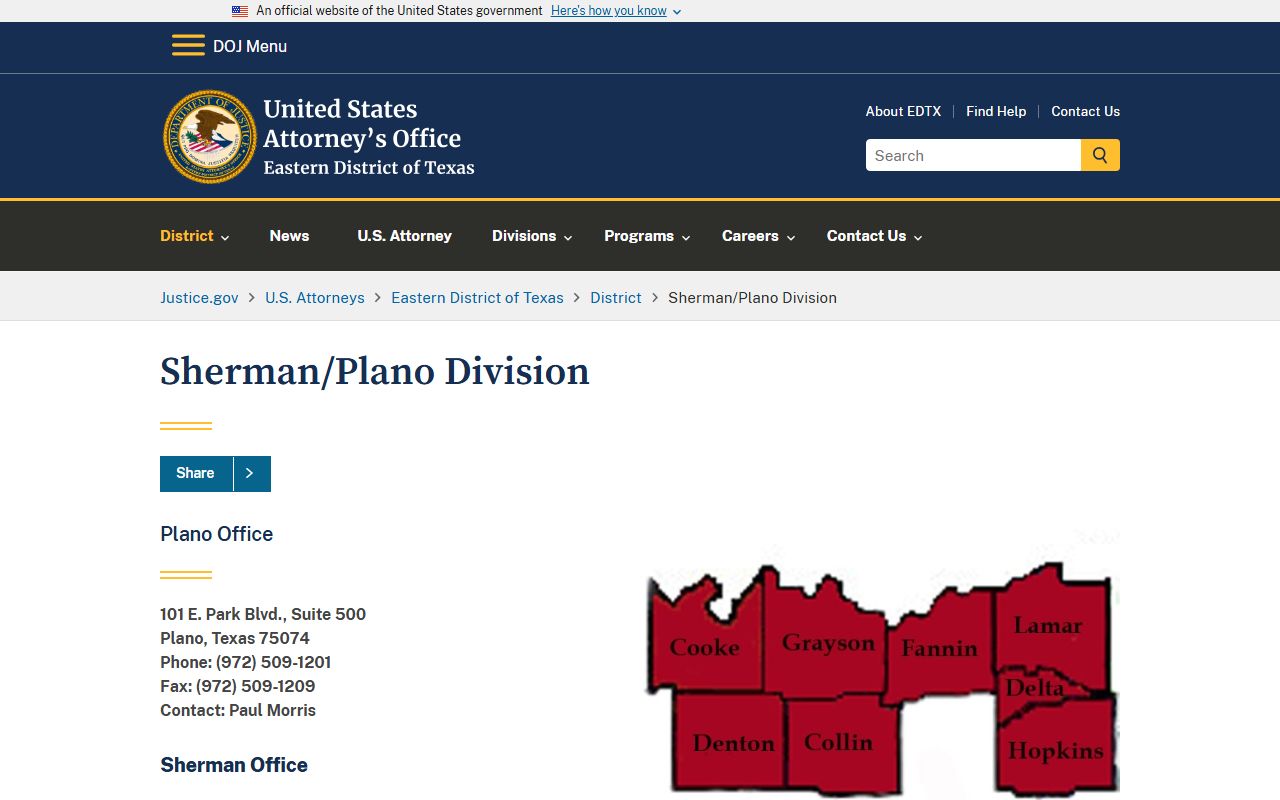
Two more federal offices serve the Sherman Division. The U.S. Attorney prosecutes federal crimes for the district. The image below shows its Sherman and Plano page.
The U.S. Attorney for the Eastern District of Texas, Sherman Division covers Denton County federal prosecutions.
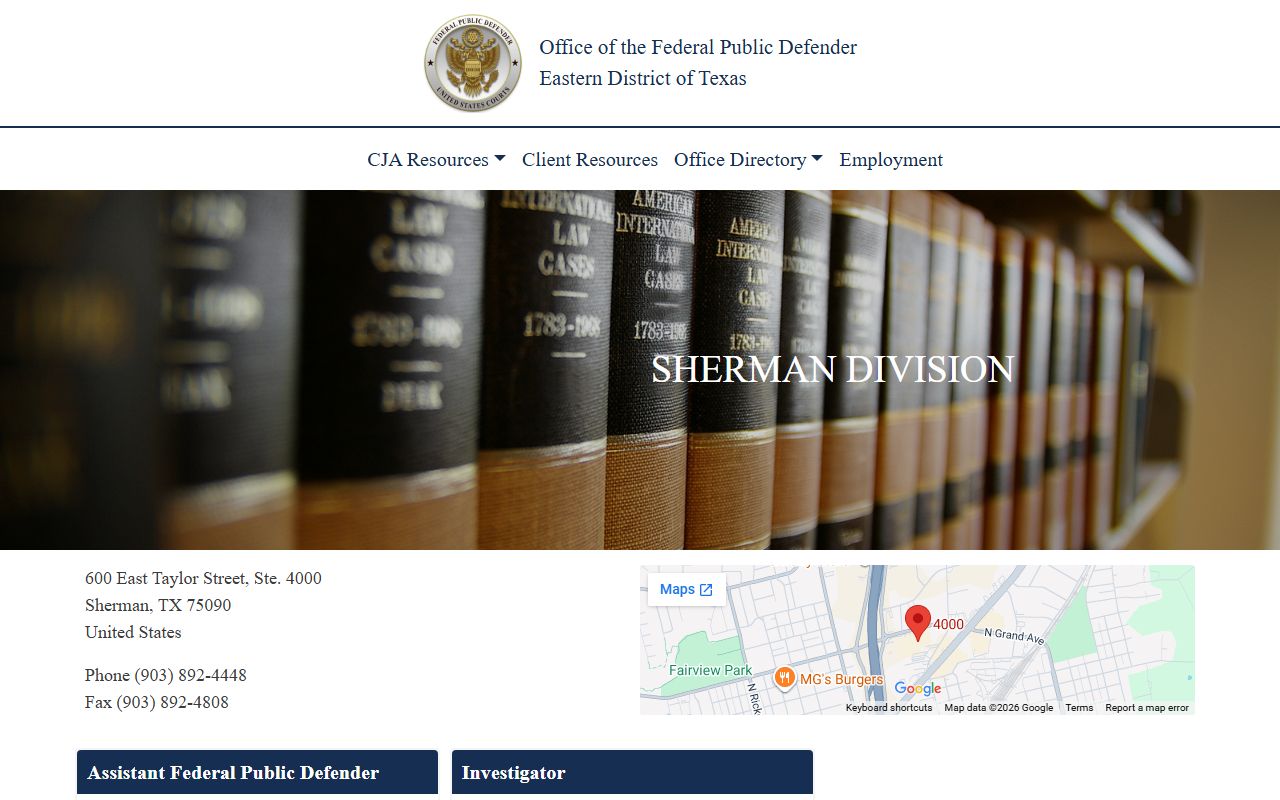
On the defense side, a person who cannot afford a lawyer in a federal case may be served by the Federal Public Defender. The screenshot below shows that office.
The Federal Public Defender, Sherman Division represents eligible federal defendants in the district.
These federal offices stand apart from Denton County offices and from the state agencies above.