
Official Denton County Jail Records Search
The county gathers its public lookup links on the Judicial and Law Enforcement Records Search page. That page points to "Denton County Records," the portal that carries court cases, court calendars, and the Sheriff's jail and bond records. So a single county portal answers two custody questions at once. One link checks whether a person was booked. A second link checks the bond tied to that booking. Both sit inside the same secure environment.
The Sheriff Services page is the other front door. It lists "Jail Records Search," "Bond Records Search," "Inmate Services and Visitation," "Open Records Request," and a "Sex Offenders List." Pick the link that matches your need and the portal opens. The screenshot below shows that Sheriff hub.
The county Denton County Sheriff's Office page outlines the office duties, including running the county jails.
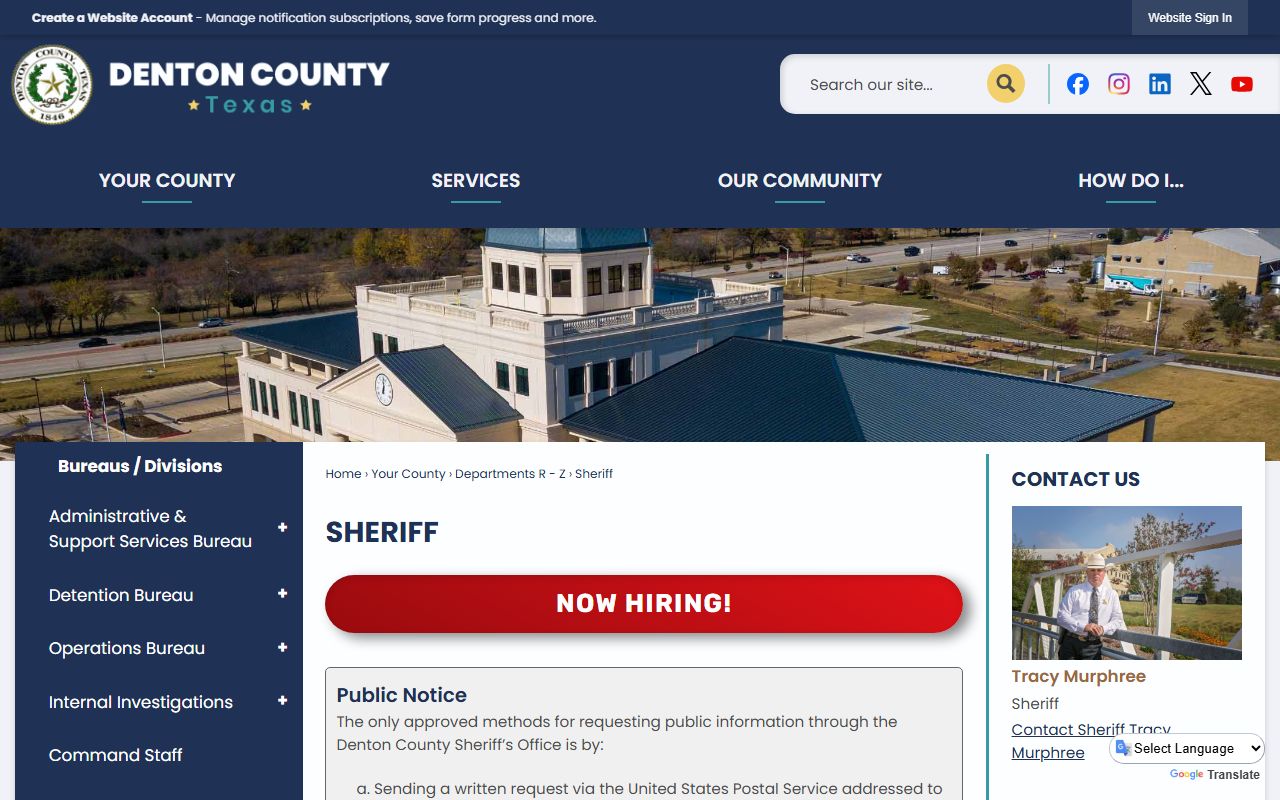
From that page you reach the records search links rather than the case portal itself.
The portal sits behind a session screen. A noninteractive check could not capture the input boxes because the page redirects to a login or session step. Follow the on-screen prompts once you arrive. The county also adds a plain caution: what shows on screen depends on data entry, so verify any urgent fact by phone.
Denton County Sheriff and Records Requests
The Denton County Sheriff's Office is led by Sheriff Tracy Murphree. The office is constitutionally created, and the sheriff is the chief law enforcement officer for the county. Its listed duties include running the county jails, investigating crimes, making arrests, serving writs, and keeping court security. When the online roster does not answer your question, you can ask the Records Division for the public information it can release.
The Sheriff page limits how the public may file an information request. Only four methods are approved. You can mail the request, email it, hand deliver it, or use the office portal.
- U.S. mail to the DCSO Records Division at 127 N. Woodrow Lane, Denton, Texas 76205.
- Email to so.orr@dentoncounty.gov.
- Hand delivery to the DCSO Records Division at the same Woodrow Lane address.
- Electronic submission through the Sheriff's Office GovQA portal.
The Sheriff Services page is where most of these links live. The screenshot below shows that Services menu with the records and inmate links grouped together.
The Denton County Sheriff Services page links the jail and bond record searches plus the open records request.
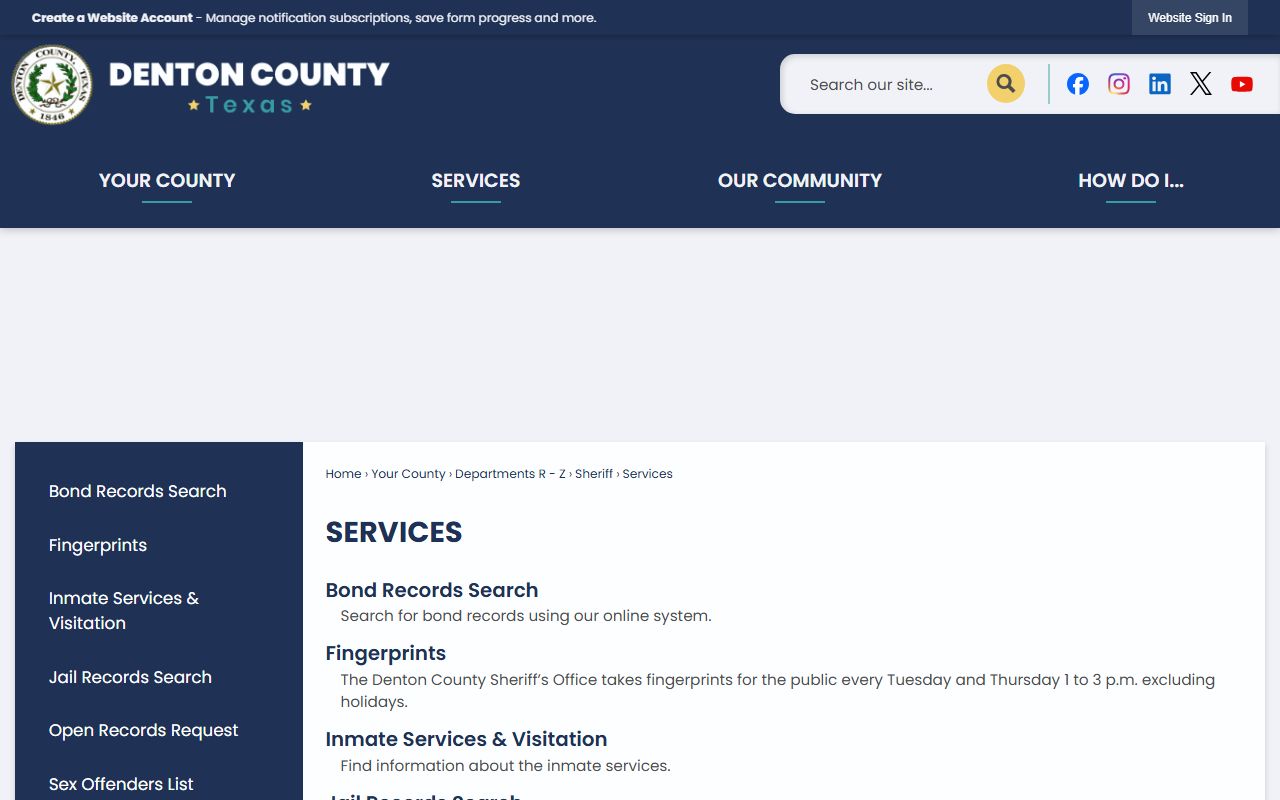
Use the Services menu as your map. Each link routes you to the right tool or form.
Denton County Jail Roster Search Fields
The portal groups its lookups into a few categories. Jail records, bond records, and case records or court calendars all sit in one place. The table below lists those categories and a key caveat. Because the portal redirects to a session screen, the exact input boxes could not be captured in a noninteractive check. So the field names you type are not listed here. The portal shows them once you load it.
| Field Label | Type | Notes |
|---|---|---|
| Jail Records Search | Portal category | Listed by Sheriff Services and the county search pages |
| Bond Records Search | Portal category | Listed by Sheriff Services and the Judicial Records gateway |
| Case Records / Court Calendars | Portal categories | The same portal also covers court records |
| Search input fields | Unknown | Not visible in a noninteractive check due to the session or login redirect |
The two custody links answer two different questions. Jail records tell you if a person was booked and is held. Bond records tell you the bond set or posted and the case context around it. Knowing which link to pick saves time. For the court file behind a charge, see the broader arrest records page.
What a Denton County Inmate Record May Show
A jail record is a set of fields the staff enter during booking. The county lists the fields a profile is expected to carry, but it does not promise that every one shows on the public roster until the live portal is checked. So treat the list below as what a profile may display, not a guarantee. The booking number tends to anchor the record, much as a cause number anchors a court file.
| Field | What It Shows |
|---|---|
| Inmate Name | The booked person's full legal name |
| Booking Number | Unique ID for the booking event |
| Booking Date / Time | When the person was booked into the jail |
| Release Date | Date of release, if it applies |
| Arresting Agency | The agency that made the arrest |
| Charge / Offense | The offense tied to the booking |
| Warrant / Case Number | The warrant or court case linked to the hold |
| Bond Amount / Type | Bond set, and how it can be posted |
| Housing / Facility | The unit or facility where the person is held |
| Demographics | Basic descriptors such as age or sex |
Do not assume the public roster reveals classification factors. Those internal notes are not built for public display. Bond fields may route you to the bond search instead. For warrant-driven holds, the warrant records page covers active warrants in more depth.
Note: A booking or arrest record does not prove guilt, since every person is presumed innocent until a court decides the case.
How to Use the Denton County Jail Roster
The roster search is short once you know the path. Gather the full name first. A booking number helps even more. Then move through the portal in order. The steps below walk through a basic lookup from start to finish.
- Open the Sheriff Services page or the Judicial and Law Enforcement Records Search page on the county site.
- Choose "Jail Records Search" to confirm a booking, or "Bond Records Search" to check a bond.
- Clear the session screen by following the on-screen prompts.
- Enter the inmate name or, if you have it, the booking number.
- Open the matching result to read the booking date, charge, and housing detail.
- For an urgent question about release or bond, call the Sheriff's Office to verify.
Results may lag behind real events. Bookings, bond changes, and court settings all flow through data entry. So a recent change might not show yet. When timing matters, a phone call beats the screen.
Denton County Jail Facilities and Capacity
The Denton County jail is not one simple building. The Detention Bureau page describes it as a 1,788-bed operation made up of a linear-style jail, a direct supervision jail, and a pre-trial facility. The Sheriff history page gives a different figure: as of 2024, the jail had a capacity of 1,499 beds and ranked number 7 among the ten largest jails in Texas. Both numbers come from official county pages, so both appear here with their source and date. The gap may reflect different definitions, dates, or operational versus design capacity.
Unit One is one part of the whole. Its Main Jail opened in 1986 in a linear style and holds 257 inmates, both male and female. The PODS section opened in 1994 in a direct supervision style, with officers inside each pod around the clock. PODS runs eight pods at 48 inmates each, for 384 total. Together Unit One holds 641, which shows it is only a slice of the full count.
| Facility / Unit | Capacity | Source / Detail |
|---|---|---|
| Denton County Jail overall | 1,788 beds | Detention Bureau page; linear, direct supervision, and pre-trial |
| Denton County Jail overall | 1,499 beds | Sheriff history page, as of 2024; ranked #7 in Texas |
| Main Jail, Unit One | 257 | Opened 1986, linear style, male and female |
| PODS, Unit One | 384 | Opened 1994, direct supervision, 8 pods of 48 |
The Detention Bureau page also covers operations. The screenshot below shows that page.
The Denton County Detention Bureau page describes the jail size and its main components.
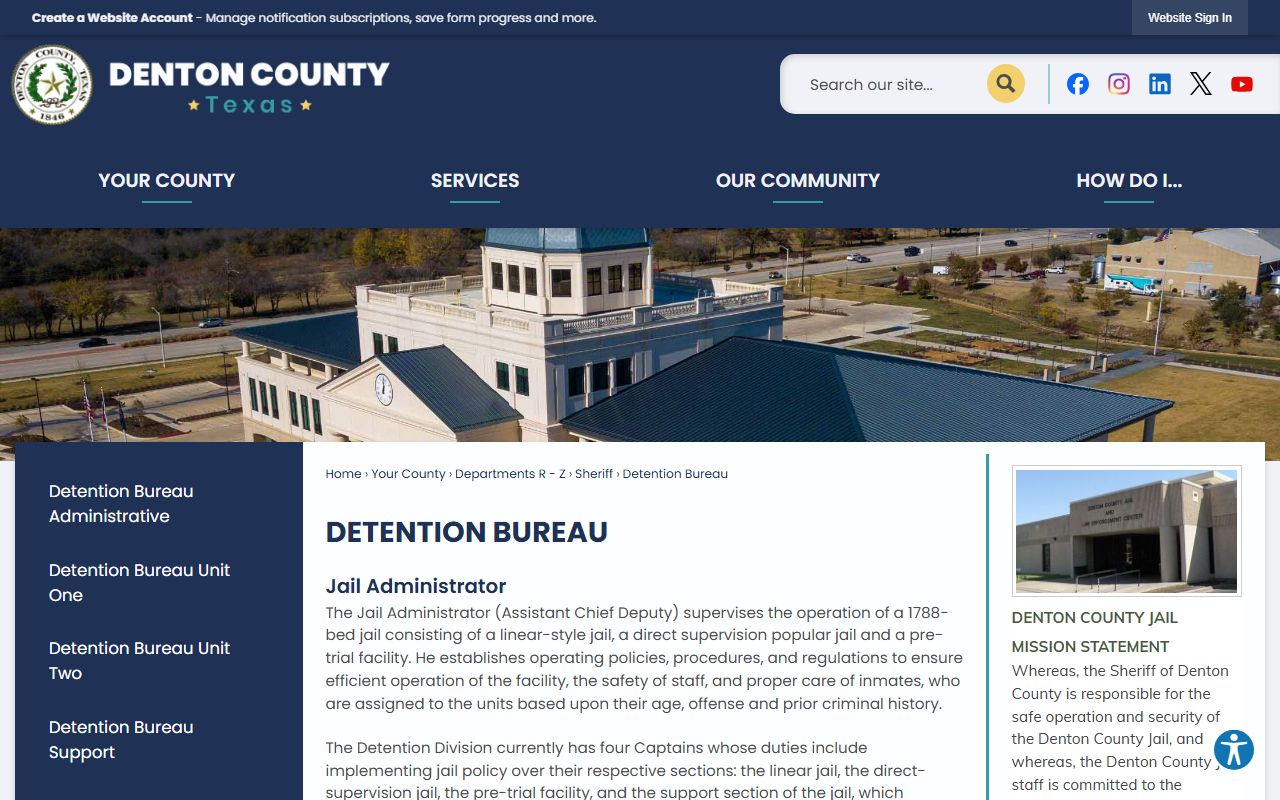
For daily counts and trends, the jail population page digs into capacity and population context.
Booking, Classification, and Bond Records in Denton County
Each booking moves through a set of support functions. The Detention Bureau lists book-in, property, classification, transport, bonds, records, and front desk operations. Put in order, those steps trace what happens after an arrest. A person is transported and booked in. Property is logged. Classification assigns housing. Bond or magistration follows, then housing, then court transport or release.
Classification is not random. The Detention Bureau page says inmates are assigned to units based on age, offense, and prior criminal history. So a first-time misdemeanor booking and a serious felony hold may land in different units. The public roster, though, is not built to reveal those internal factors, and you should not read housing as a judgment about the case.
Bond records sit beside jail records for a reason. The jail and Sheriff manage release logistics. Courts and magistrates set the bond or its conditions. Bail bondsmen operate under the rules of a county Bail Bond Board. The Unit One page describes the direct supervision design in more detail. The screenshot below shows that page.
The Denton County Detention Bureau Unit One page lists the Main Jail and PODS capacities and their staffing.
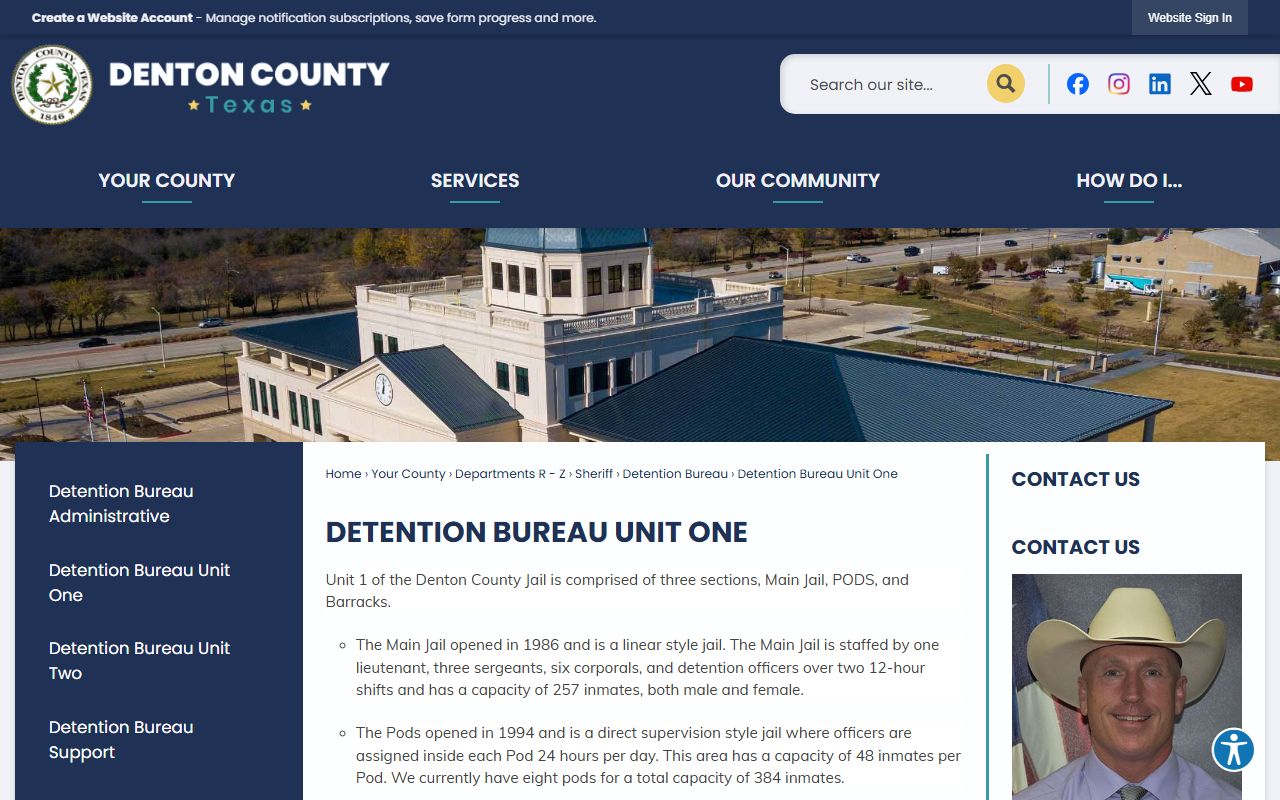
Use the bond search for bond facts and the jail search for custody facts.
Verifying Release Status
The roster can show a release date when the field is filled. Still, the screen may lag behind the actual event. Bookings and releases pass through data entry, so a fresh release might not post right away. When the timing matters, do not rely on the screen alone.
Call the Sheriff's Office to confirm an urgent release or a bond change. A phone check beats guessing from a stale record. For people who have already left county custody, the released inmates page covers state and federal release tools and notification sign-ups in more depth.
State Prison and Federal Custody
The Denton County Jail is not the same as a state prison. A county jail holds people pretrial and those serving short sentences. The Texas Department of Criminal Justice runs the state prison system, which is a separate agency with its own records. So a person sent to state prison after conviction no longer shows on the county roster. Their record moves to the state system.
Federal custody is a third track. People held on federal charges or in Bureau of Prisons custody are found through the federal inmate locator, not the county tool. These three systems do not share one search box. If the county roster shows no result, the person may sit in state or federal custody instead. The released inmates page links the state and federal locators side by side.
Denton County Jail Contact Information
The jail and the Sheriff's Office share the Law Enforcement Center on Woodrow Lane. That site handles booking, records, and the front desk. Bring a valid ID and the inmate name or booking number when you visit in person. The card below lists the main address and phone.
Denton County Sheriff's Office and Jail
Law Enforcement Center
127 N Woodrow Lane
Denton, TX 76205-6397
940-349-1600
DCSO Records Division
127 N Woodrow Lane
Denton, TX 76205
Email: so.orr@dentoncounty.gov
Mail, hand delivery, or GovQA portal
For privileged legal visits, attorneys should contact the jail or use the official visitation resources, since public video rules may not apply to attorney access. The Records Division handles open information requests by the four approved methods above.
Mail, Money, and Visitation Overview
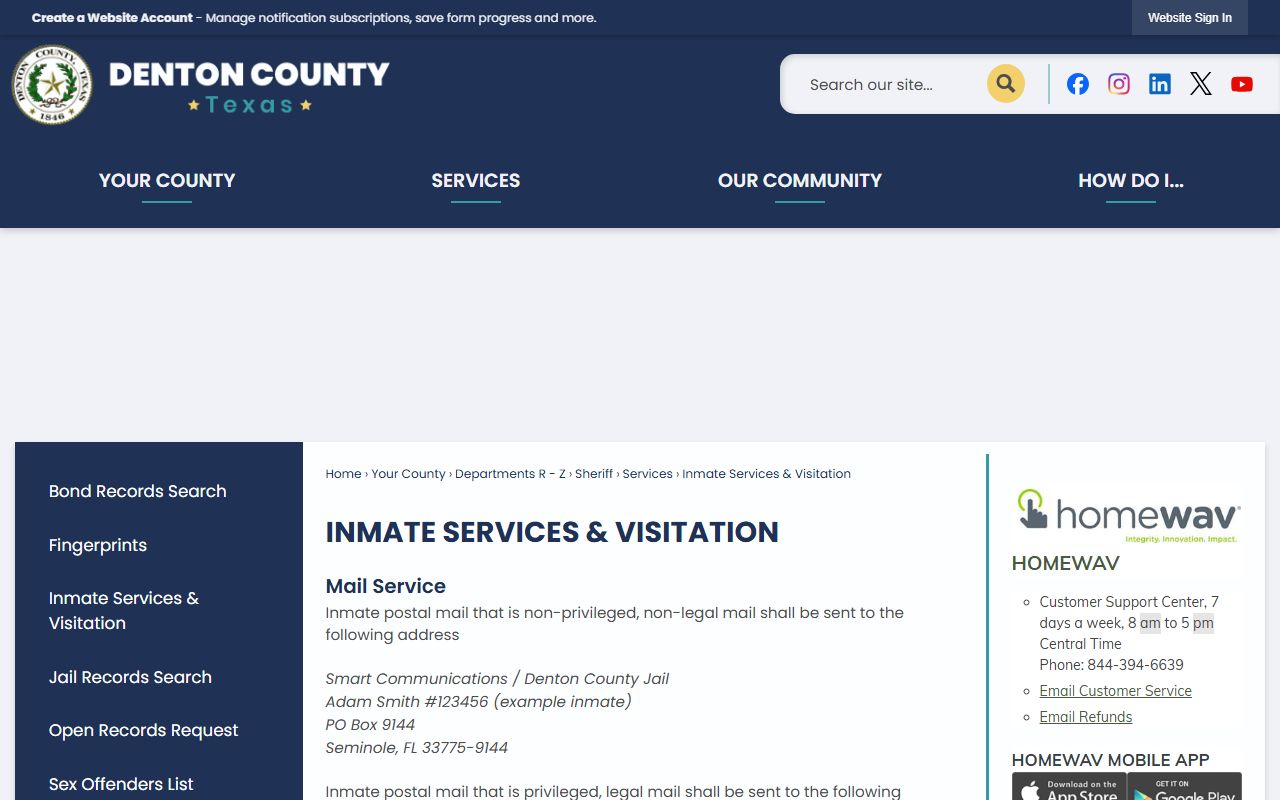
Contact with an inmate runs through a few vendors, and each one has its own rule. Regular mail does not go to the jail at all. Non-legal postal mail goes to Smart Communications, addressed to the Denton County Jail, with the inmate name and booking number, at PO Box 9144, Seminole, FL 33775-9144. That mail is scanned and shown to the inmate on a kiosk. Legal or privileged mail is the exception. It goes straight to the jail at 127 N Woodrow Lane in Denton.
Money has two separate tracks. Friends and family fund a commissary account through CorrectPay.com or by calling 1-855-836-3364. Phone debit is different. Those funds go through smartinmate.com. No money is accepted by mail, and money cannot move from one inmate to another.
All visits are by video. Visitors register with HomeWAV for both on-site and remote visits. On-site public visits must be scheduled, while remote-home visits are started by the inmate, not booked by the visitor. The schedule below lists the day and time windows. The screenshot shows the inmate services and visitation page.
The Denton County inmate services and visitation page sets the mail, money, and video visit rules.
| Visit Type | Schedule | How It Works |
|---|---|---|
| On-site public video visits | Saturday 8:00 a.m. to 7:30 p.m. | Schedule at least 24 hours ahead; public entrance on the Woodrow Street side |
| Remote-home visits | Sunday to Saturday 7:30 a.m. to 9:00 p.m. | No visitor scheduling; the inmate starts the visit |
On-site visits can be suspended at the Sheriff's discretion. Eligible inmates get up to two free public visits per week.
Confidential Jail Information and Innocence
Not every detail is public. The roster is built to confirm custody, not to expose internal records. Classification factors, medical notes, and security details are kept back from public view. So a public search answers basic questions: who is held, when they were booked, and what charge brought them in. It does not open the inmate's full file.
A booking record is also not a conviction. An arrest or jail record marks a charge, not a verdict. Every person is presumed innocent until a court decides the matter. Read a roster entry as a snapshot of custody, not proof of guilt. For the court case behind a charge, the court records page tracks the filing through to its outcome.
Denton County Jail History and Expansion
The jail grew in stages, which is why it has several parts today. The Sheriff history page traces the path. A 1964 jail on McKinney Street housed just 75 inmates. From there the county added pieces one at a time as demand rose.
- 1985: the administration and main jail building.
- 1994: the PODS direct supervision section.
- 2004: the pre-trial facility.
- 2015: the tower.
- 2018: the book-in addition.
- 2022: the kitchen and laundry expansion.
That history explains the layout. Rather than one block, the jail is a set of components joined over decades. It also frames why two capacity numbers exist. As the county grew, the count and its definitions shifted with each build. The arrest records page connects the booking side to the court side of a case.