
Denton County Probate Courts
Denton County runs two statutory probate courts. They sit at one address and share the same building, but each has its own judge and its own docket. Probate Court No. 1 is headed by Hon. David W. Jahn. Probate Court No. 2 is headed by Hon. Christopher J. Everett. Cases get divided between the two courts, so the court number on a file tells you which judge hears it.
A statutory probate court is a specialized court. It does estates and guardianships full time, unlike a general county court that splits its days among many case types. That focus matters when a will is contested or a guardianship gets complex. The two courts share one physical office for filings and hearings.
Probate Court No. 1 (Hon. David W. Jahn)
3900 Morse Street, Suite 100
Denton, TX 76208-4524
Probate Court No. 2 (Hon. Christopher J. Everett)
3900 Morse Street, Suite 100
Denton, TX 76208-4524
If you are not sure which court holds a case, the case or cause number is the key. The clerk can route you to the right court once you give a name or a number.
The Denton County Probate Clerk and County Clerk
The judge and the clerk are not the same office. In Denton County, the County Clerk is the probate clerk and the custodian of probate court records. The clerk accepts filings, keeps the case files, and fills copy requests. The judge hears the case. So a will, an inventory, or an account is filed with the clerk, not handed to the judge.
The Local Rules of the Statutory Probate Courts spell this out. When the rules say "Clerk," they mean the probate division of the Denton County Clerk's office. That is the office to contact for filings and for records. You can read more about that office on the Denton County Clerk page, which also covers deeds, marriage records, and other recorded documents.
This split is normal in Texas. The probate court and the probate clerk work side by side, but they are separate roles. Knowing the difference saves a wasted trip.
What Denton County Probate Records Cover
Probate is broader than wills. The Denton County probate courts handle a wide set of matters, and the records reflect all of them. A probate file can hold an estate, a guardianship, or a mental health commitment. It may include trusts and ancillary matters tied to an estate. The court also reviews inventories, annual accounts, and the final settlement that closes a case.
Some of the most common record types you will see:
- Estates and wills - applications to probate a will, letters testamentary, and the will itself once admitted.
- Guardianships - cases protecting a minor or an incapacitated adult.
- Mental health commitments - involuntary commitment proceedings with sensitive medical detail.
- Small estate affidavits - a short path for small estates without a full administration.
- Inventories and accounts - lists of estate assets and yearly accounting filed by the representative.
- Trusts and ancillary matters - related litigation and trust questions tied to an estate.
The court also makes ad litem appointments and runs a court visitor program. Because of that, the names of court-appointed attorneys and ad litems often show up in the docket entries.
How to Search Denton County Probate Records
Start with the case number if you have one. Probate cases are filed with the County Clerk, so the clerk's court records search is the first stop for case detail. For recorded instruments tied to an estate, the County Clerk also runs an official records search, though full probate case detail usually routes through the court records portal rather than the deed index. The page below is the county's own standing-orders hub for the probate courts.
The Denton County Standing Orders of the Court page gathers probate court forms, orders, and procedures in one place.
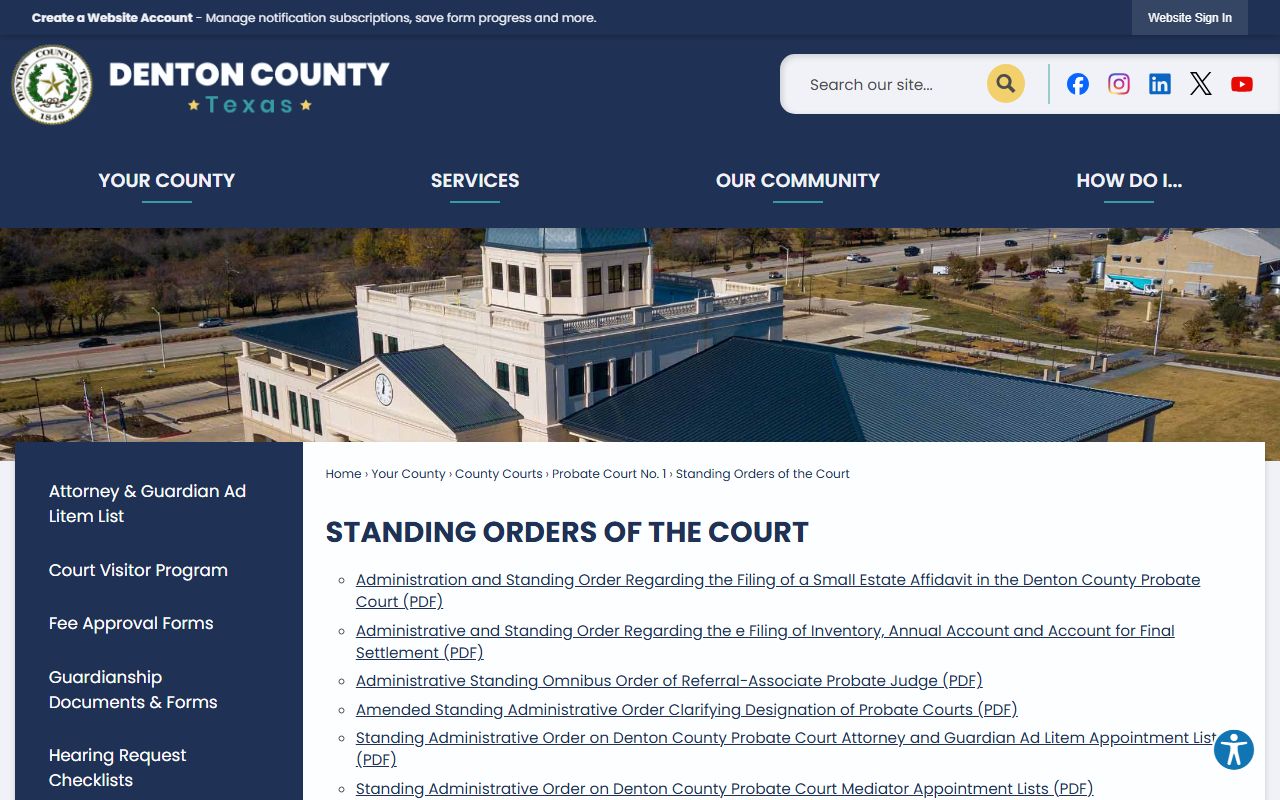
That page links small estate affidavit filing, inventory and annual account e-filing, ad litem and mediator lists, and mental health procedures. If a probate record is not online, the fallback is simple. Request a copy through the County Clerk, who serves as the probate clerk. Give the case number, the party names, and the document title so the clerk can find it. Older files in particular may need a manual pull.
Denton County Probate Filing Fees
Probate filing fees in Denton County are split into a local part and a state part. Each adds up to a total. The fee you pay depends on the kind of case. A routine estate, guardianship, or mental health case costs one rate. Contested and civil matters cost different rates because they take more of the court's time. Ancillary cases carry no charge.
| Fee Description | Amount |
|---|---|
| New probate, guardianship, mental health, or transferred case: local fee | $223 |
| New probate, guardianship, mental health, or transferred case: state fee | $137 |
| New probate, guardianship, mental health, or transferred case: total | $360 |
| Adverse probate: local fee | $75 |
| Adverse probate: state fee | $45 |
| Adverse probate: total | $120 |
| New civil case in probate: local fee | $213 |
| New civil case in probate: state fee | $137 |
| New civil case in probate: total | $350 |
| Adverse civil action in probate: local fee | $35 |
| Adverse civil action in probate: state fee | $45 |
| Adverse civil action in probate: total | $80 |
| Ancillary cases | No charge |
The split tells a story. Routine estate work opens at one fee, while a contested or civil action costs more or less depending on its type. Knowing which bucket a filing falls in helps you plan the cost before you file.
Note: filing fees are set by the court and can change, so confirm the current amount with the County Clerk before you submit a probate application.
Local Rules for Denton County Probate Cases
The Local Rules of the Statutory Probate Courts of Denton County took effect October 1, 2024. They govern how the two courts run their probate cases. The stated goal is uniformity and fairness across both courts, to promote justice in estate, guardianship, and related matters. The new rules repealed the prior local rules, so older guidance no longer applies.
The rules carry their own set of definitions. A few terms matter for anyone reading a probate file:
- Testator
- A person who has made a valid will to direct how their property passes at death.
- Executor
- The person named in a will to carry out its terms and settle the estate.
- Administrator
- A person the court appoints to settle an estate when there is no will or no named executor.
- Intestate
- Dying without a valid will, so state law decides who inherits.
- Guardianship
- A court case that protects a minor or an adult who cannot manage their own affairs.
- Conservatorship
- A court-ordered arrangement giving one person legal authority over another's care or property.
The local rules also say that supplemental forms, procedures, and policies live on the court websites. So the rule text and the standing-orders page work together. Check both when you prepare a filing.
The Attorney Requirement in Denton County Probate
This rule surprises many people. The Denton County probate courts do not let a self-represented litigant represent an estate or another person. A named executor, an administrator, or a guardianship applicant generally must act through legal counsel. You can represent your own individual interest. You cannot represent a ward, an estate, beneficiaries, heirs, or creditors unless you are a licensed attorney.
The reason is the rule against the unauthorized practice of law. When someone files probate or guardianship papers while trying to represent an estate, the courts will take no action on those documents unless an attorney of record appears. In plain terms, filing papers on your own may not move the case forward. The case can stall until counsel is on file.
Important: If you are a named executor, administrator, or guardianship applicant, the Denton County probate courts generally require you to act through a licensed attorney, not on your own.
So the line is simple. Your own interest, you can handle. Someone else's interest, you need a lawyer.
Guardianships and Mental Health Records in Denton County
Probate is not only about death. The Denton County probate courts also handle guardianships and mental health commitments. A guardianship protects a minor or an incapacitated adult who cannot manage their own care or money. A mental health case can involve involuntary commitment, and the probate courts keep standing orders for these proceedings.
Access to these records is often more limited than ordinary civil files. Mental health commitments include sensitive medical information, and Texas mental health and confidentiality law restricts who can view them. A case index may exist, but the full file can be closed to the public. Probate files in general can hold personal, medical, financial, and minor or incapacitated-person details, so the court guards them closely.
For records on divorce decrees, custody, and other family matters that sit in district court rather than probate, the Denton County marriage and divorce records page covers where those live and how to request them.
Small Estate Affidavits in Denton County
Not every estate needs a full administration. A small estate affidavit is a shorter path for estates that meet the legal limits. The Denton County standing-orders page covers small estate affidavit filing along with the other probate procedures, so the form and the rules sit in one place.
A small estate affidavit can let heirs collect property without opening a full estate, when the case qualifies. It is a probate filing, so it goes to the County Clerk like other probate papers. The affidavit becomes part of the public probate record once filed and approved.
Because the rules and the limits are specific, many filers still consult an attorney even for a small estate. The court's standing orders and the local rules set out what the affidavit must include.
Contested and Ancillary Probate Matters in Denton County
A probate case can include real litigation. The local rules define an ancillary matter broadly. It covers lawsuits by or against a personal representative, or on behalf of an estate, that do not concern routine estate administration. The rules give examples, and they show how far a probate case can reach.
Ancillary matters named in the rules include:
- Note collection on a debt owed to or by the estate.
- Personal injury claims tied to the estate.
- Breach of fiduciary duty against a representative.
- Breach of contract involving the estate.
- Trust litigation connected to the case.
The rules also define contested matters as litigated matters with opposing parties. That is why some probate filings cost more. Adverse probate and adverse civil actions carry their own fees, which is why the fee table separates them from routine estate opening. A contested case draws on more of the court's time, and the records grow with each pleading, motion, and order. For the broader picture of how civil and family cases flow through the county, see the Denton County court records page and the Denton County District Clerk page, which handles district court civil and family files.