
How to Look Up Denton County Jail Population Data
Jail population data does not live in one tidy box. It is spread across a few official sources. The Denton County Sheriff's Office runs the Detention Bureau, and its pages describe the jail, its units, and how inmates are housed. Those pages give you capacity and structure. They do not post a running daily head count. For that, you go up a level to the state.
The Texas Commission on Jail Standards, or TCJS, is the agency that inspects county jails and collects monthly population reports. It tracks bed counts, daily population, and compliance for every county jail in the state. If you want the most current Denton County population figure, the TCJS monthly report is the right place to look. For county context, like how fast the area is growing, the U.S. Census Bureau QuickFacts page is the official source.
Each source answers a different question. Use them together.
- Sheriff Detention Bureau pages - jail design, units, bed capacity, classification, and staffing.
- Texas Commission on Jail Standards - monthly population counts, inspection reports, and capacity definitions.
- U.S. Census QuickFacts - county population and growth as background, not jail data.
The Sheriff history page is a good starting point for capacity facts. The image below shows that page, which traces how the jail grew over time.
The county History of the Denton County Sheriff's Office page gives the jail's expansion record and a 2024 capacity figure.
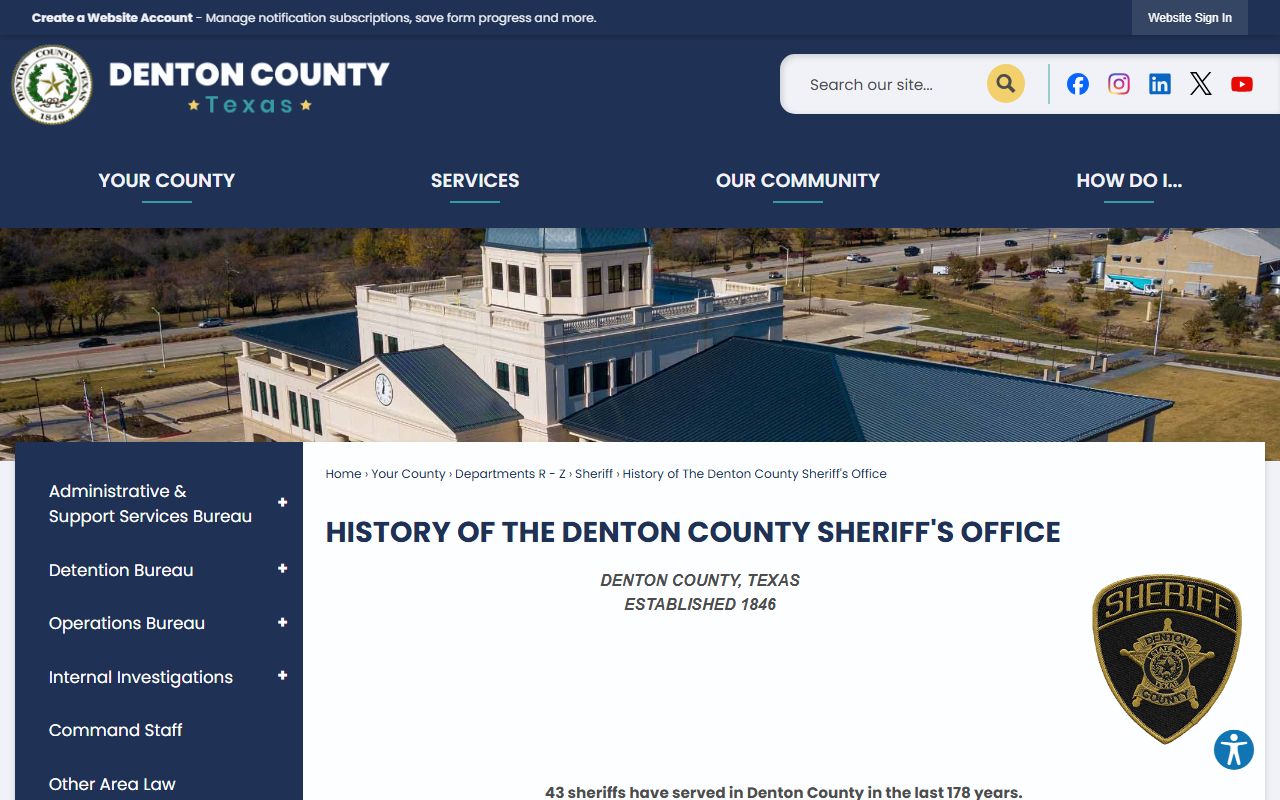
That same page ranks the jail among the largest in Texas, which helps you size the population against other counties.
Denton County Jail Capacity Overview
Capacity is the number of beds the jail is built and approved to hold. It sets the ceiling for the inmate population. Denton County's jail did not appear all at once. The Sheriff history page records expansions in 1985, 1994, 2004, 2015, 2018, and 2022. Each round added beds as the county grew. The county's very first jail was a two-story log building, and inmates burned it in 1868, which forced temporary housing in Collin County. The modern operation is a different animal.
Two official county pages give two different overall bed counts. They do not match. The Detention Bureau page describes a 1,788-bed jail. The Sheriff history page lists a 1,499-bed capacity as of 2024 and ranks the jail number seven among the ten largest in Texas. Both are county sources. Neither should be dropped. The gap may reflect different dates, different definitions of design versus operational capacity, or a recent update on one page but not the other.
Important. Two official Denton County pages list different overall bed counts: a 1,788-bed figure on the Detention Bureau page and a 1,499-bed figure on the Sheriff history page as of 2024. No single number is presented here as the one true capacity. Check the latest TCJS inspection to confirm the current approved bed count before relying on either figure.
The table below lays out every capacity figure with its source and date. Read it as a map of what the county states, not as proof of a daily count.
| Facility / Unit | Capacity | Source / Date |
|---|---|---|
| Jail overall | 1,788 beds | Detention Bureau page |
| Jail overall | 1,499 beds | Sheriff history page, as of 2024 (ranked #7 in Texas) |
| Main Jail, Unit One | 257 | Unit One page, opened 1986, linear style |
| PODS, Unit One | 384 | Unit One page, opened 1994, 8 pods x 48 |
| Barracks, Unit One | Not located | Listed on Unit One page; capacity not stated |
| Pre-trial facility | Not located | Named by Detention Bureau; capacity not stated |
Note: the Unit One Main Jail and PODS add up to 641 beds, so Unit One is only part of the total and the rest sits in the pre-trial facility, Barracks, and other parts.
Inside Denton County Jail Unit One
Unit One shows how jail design changed over the years, and design drives how the population is housed. Unit One holds three parts: the Main Jail, the PODS, and the Barracks. The Main Jail opened in 1986. It uses a linear style, where cells line a corridor and officers walk past to check on inmates. Its capacity is 257, and it holds both male and female inmates. Staffing runs one lieutenant, three sergeants, six corporals, and detention officers across two 12-hour shifts.
The PODS opened in 1994 and use a newer model called direct supervision. Officers sit inside each pod 24 hours a day, rather than walking a hallway. Each pod holds 48 inmates. There are eight pods, for a total of 384. The Barracks is the third piece of Unit One, but the official excerpt did not list its capacity, so that number stays unknown here.
The two styles, linear and direct supervision, sit side by side in the same jail. That tells you the population is split across older and newer housing as the facility expanded.
How Denton County Sorts the Jail Population
Not every inmate is housed the same way. The jail assigns people to units based on a few factors. The Detention Bureau states that inmates are cared for and housed by age, offense, and prior criminal history. Classification is the process that turns those factors into a housing decision. It keeps the population organized and aims to keep both staff and inmates safe.
Classification is one of the support functions inside the Detention Bureau. It works alongside book-in and records to track each person from intake to release. The factors are short to list.
- Age - separates younger and older inmates where the rules call for it.
- Offense - the charge or charges tied to the booking.
- Prior criminal history - past record that may affect housing and risk level.
Because housing follows these factors, the makeup of any single pod or unit can shift day to day. The county does not publish a public breakdown of how many inmates fall into each class. For an individual person's charges and booking, see the inmate records page instead.
Detention Bureau Staffing Structure
Staffing shapes how the population is managed, so it helps to know how the bureau is built. The Detention Bureau is run by a jail administrator who oversees the whole operation. Under that role sit four captains. Each captain leads one area of the jail.
The four captain areas are the linear-style jail, the direct-supervision jail, the pre-trial facility, and support. Support is the engine room. It covers the back-office and front-line tasks that move an inmate through the system.
- Book-in and property handling at intake.
- Classification and housing assignment.
- Transport to and from court.
- Bonds, records, and the front desk.
The detention chain of command runs from captains down through lieutenants, sergeants, corporals, and detention officers. The jail mission stresses safe, humane care under the U.S. Constitution and Texas Commission on Jail Standards rules, with programs open to every inmate. Effective January 1, 2025, the role of Assistant Chief Deputy and Jail Administrator took on day-to-day jail operations, including housing, booking, classification, programs, records, and release.
Note: staffing facts here come straight from official county pages, and no officer-to-inmate ratio is stated because the county did not publish one.
Denton County Growth and Jail Demand
Denton County is one of the fastest-growing large counties in North Texas. More residents can mean more arrests, more court cases, and more pressure on the jail. But growth alone does not prove the jail population rose. It only sets the backdrop. The Census numbers tell the growth story clearly.
The U.S. Census Bureau counted 662,614 residents in 2010 and 906,422 in 2020. The July 1, 2024 estimate is 1,045,120. That is a 15.3% increase from 2020 to 2024 alone. The jail expanded several times across those years, which lines up with a growing county. Still, capacity growth and population growth are not the same as a higher daily inmate count.
The image below shows the Census QuickFacts page for the county, the official source for these figures.
The U.S. Census QuickFacts for Denton County page lists the county's population counts and estimates.
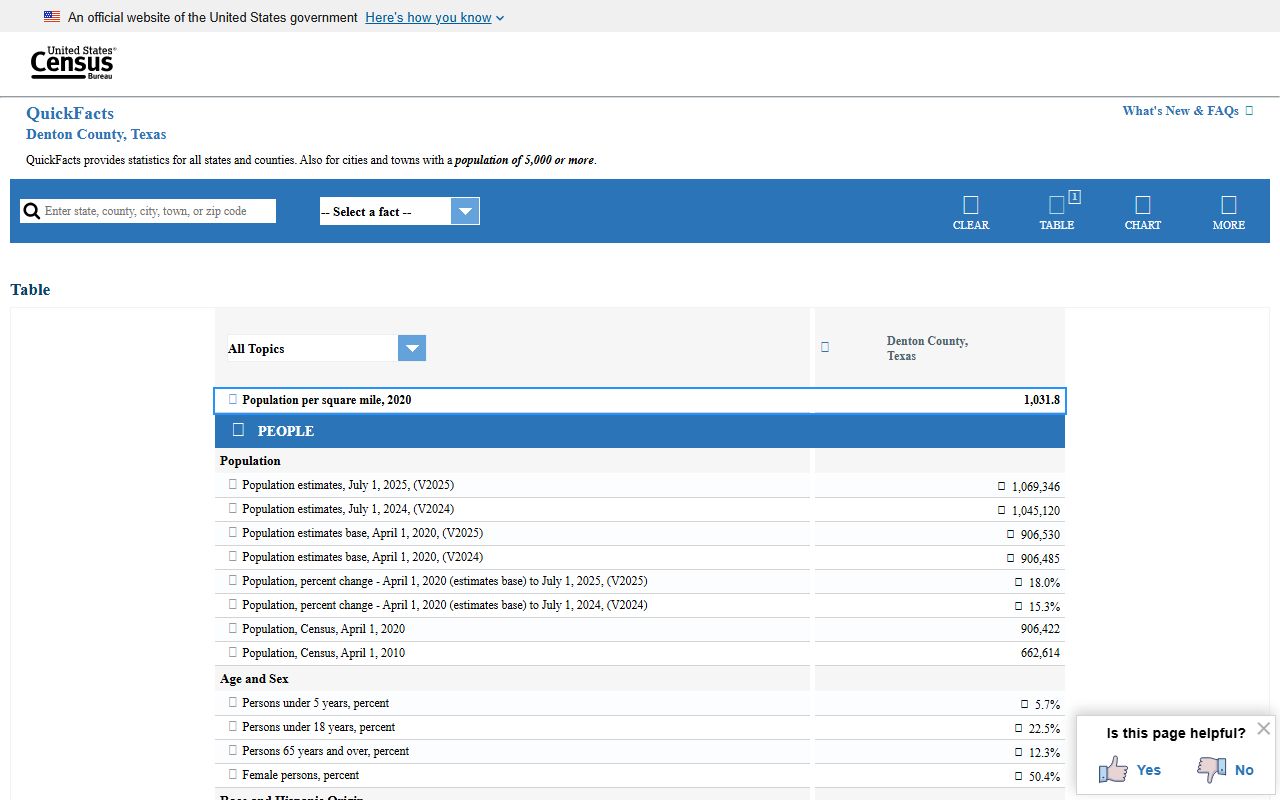
Use these counts as county context only. They do not stand in for the inmate population, and the daily jail count comes from TCJS, not the Census.
Denton County Jail Population Data Gaps
Some numbers people want simply are not posted by the county in the sources reviewed. It is fair to say so plainly. The average daily population is not published on the Sheriff pages. The demographic breakdown of the jail, by race, age, or sex, is not posted. The split between people held before trial and people already sentenced is not stated either. None of these were located in the official county sources.
When county pages do not carry a figure, the right move is to go to the state. The Texas Commission on Jail Standards publishes monthly population reports for every county jail, and those reports are the best place to find the missing daily and trend numbers.
Below is a plain comparison of what the county does publish against what it does not. Each row is marked county-specific or context.
| Data Point | Status | Scope |
|---|---|---|
| Overall bed capacity | Published (two figures) | County-specific |
| Unit One Main Jail and PODS beds | Published | County-specific |
| Classification factors | Published | County-specific |
| Average daily population | Not located on county pages | Check TCJS |
| Demographic breakdown of inmates | Not located | Check TCJS |
| Pretrial vs sentenced split | Not located | Check TCJS |
| County population and growth | Published | Census context, not jail data |
Do not read overcrowding into the gap. Without a TCJS daily count next to the capacity figure, no claim about crowding is supported here.
National Context for Denton County Jail Population
Since the county does not post a per-100,000 jail rate, broad context can only come from research bodies, not from Denton County itself. Two are worth naming. The Bureau of Justice Statistics, or BJS, is a federal agency that publishes national jail data. The Vera Institute of Justice tracks incarceration trends across states and counties.
Both are useful for general background. Neither is a Denton County government source. So their figures should be read as context, not as the county's own numbers. The research did not pull a specific county-versus-state-versus-national rate, and inventing one here would mislead. For that reason, the figures stay labeled as outside context, and the comparison sticks to what the county actually states rather than a guessed rate.
If you need a true comparison rate, pull the Denton County daily count from TCJS first, then set it against BJS national figures yourself. That keeps the county number county-sourced and the national number federally sourced.
Recent Developments Affecting the Jail Population
One recent change is worth flagging because it can touch who is held in the jail. On January 15, 2026, the Denton County Commissioners Court voted to expand the Sheriff's Office 287(g) agreement with ICE. The expansion moves from jail-based enforcement toward a task-force partnership for immigration enforcement. Programs like 287(g) let local officers carry out certain federal immigration functions, which can affect federal holds and the jail's intake mix.
The image below shows the news coverage of that vote.
KERA's report on the Denton County expansion of the Sheriff's 287(g) agreement with ICE covers the Commissioners Court decision.

Note: the county has not published a population figure tied to this change, so its effect on the daily count is not yet documented in official sources.
Looking Up Individual Inmates by Name
This page is about counts and capacity, not single people. If you need to find one person currently in custody, that is a name-based search, and it lives on a different page. The Denton County inmate records page covers the jail roster and how to search by name. For people who have left custody, the released inmates page is the right stop, and arrest records cover bookings and charges. For broader case history, the home page links every record type.